Japan-based space startup Letara has secured ¥2.6 billion (approximately $16 million) in new funding to transition from academic research and demonstrations to a commercial business, with plans to expand its hybrid propulsion systems into large rocket systems for space, defense, and security markets.
Key Takeaways
- Letara raised ¥2.6 billion (~$16 million) in a funding round co-led by Headline Asia, JIC Venture Growth Investment, and Incubate Fund.
- The company will use the funds to move beyond demonstrating its thruster in space and explore wider use cases in space, defense, and security.
- Letara’s hybrid rocket design uses inexpensive materials like plastic and rubber as solid fuel, aiming to solve thrust, performance, and combustion control issues.
- The global hybrid rocket propulsion market is projected to grow from $848 million in 2024 to $2.6 billion by 2032.
- Letara has already won orders from rocket and satellite companies and the Japanese government, with an in-orbit firing test with an overseas partner as the next milestone.
Funding and Expansion Plans
Letara, a startup based in Sapporo, has raised ¥2.6 billion (approximately $16 million) in new funding. The round was co-led by Headline Asia, JIC Venture Growth Investment, and Incubate Fund. Strategic investors include NES Corporation, an energy company; Toyoda Gosei, a Toyota Group supplier; and Frontier Innovations, a Greece-based IT company.
Shota Hirai, co-CEO of Letara, shared the company’s expansion plans with TechCrunch. With this funding, Letara will move beyond demonstrating its thruster in space and will explore a wider range of use cases in space, defense, and security, developing hybrid rocket systems for each.
Hybrid Rocket Technology
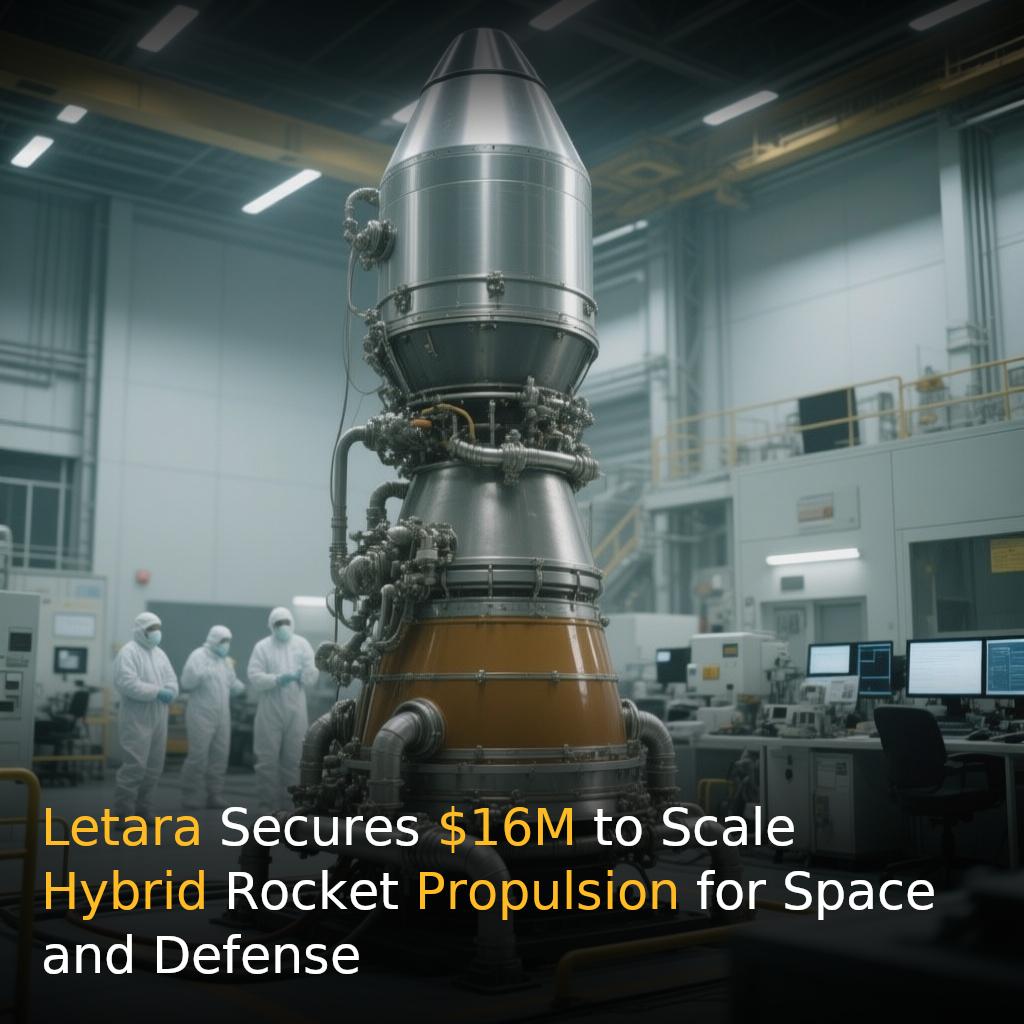
Letara’s hybrid rocket design keeps solid fuel separate from liquid oxidizer, using inexpensive materials like plastic and rubber as solid fuel. The company has developed a proprietary manufacturing process that mixes, shapes, and compresses solid fuel materials to ensure reliable ignition and consistent burning.
This system can deliver more thrust with less waste than traditional hybrid rockets that often use expensive paraffin wax. Letara aims to solve three problems limiting hybrid propulsion: generating sufficient thrust, maintaining performance, and controlling combustion.
Market and Competition
The global hybrid rocket propulsion market is projected to grow from $848 million in 2024 to $2.6 billion by 2032, at a CAGR of 15%. Competitors in hybrid rocket technology include Japan’s Interstellar Technologies, China’s Galactic Energy, South Korea’s InnoSpace, and Singapore’s Equatorial Space.
German startup HyImpulse and Australian Gilmour Space are also pursuing hybrid rocket technology, along with various U.S. companies developing competing propulsion and launch systems.
Background and Founding
Letara was founded based on research by co-CEOs Landon Thomas Kamps and Hirai at Hokkaido University, where they studied rocket propulsion. The founders believed hybrid rockets’ safety and simplicity could make them useful beyond traditional space programs, especially as private companies enter the industry.
Letara was spun out of Hokkaido University in 2020, initially focusing on satellite thrusters. The global propulsion market has become more crowded, and Letara is now pursuing defense contracts and launch services to compete globally.
Target Customers and Milestones
Hirai noted that large spacecraft need high thrust propulsion for maneuvers like going from LEO to GEO and passing through the Van Allen belt quickly. Letara is targeting satellite makers, operators, launch companies, and governments, with commercial satellites as its biggest market for in-space propulsion.
The company has already won orders from rocket and satellite companies and the Japanese government, though the contract values were not disclosed. Letara’s next major milestone is an in-orbit firing test with an overseas partner, which it sees as key to commercialization.
Manufacturing and Sustainability
To support production at scale, Letara will need to establish a repeatable manufacturing process with quality controls and a reliable supply chain for fuel and tanks. The company said that using recycled plastic as fuel is ‘very much a possibility’ with its hybrid technology, but more testing and development would be needed.