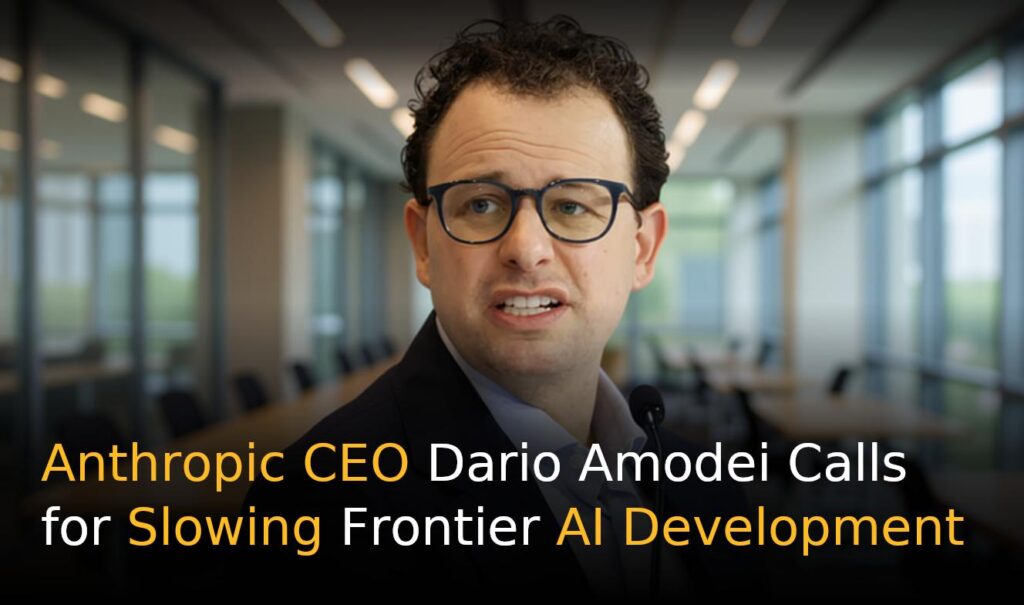
Dario Amodei, chief executive of Anthropic, has called on the artificial intelligence sector to slow the advancement of cutting-edge AI, arguing that the technology is progressing faster than safety precautions can match. His proposal, published in an essay titled “We Must Pace the Frontier,” sets out a three-phase plan to pace frontier AI development and arrives amid intensifying debate over AI safety and alignment.
Key takeaways
- Amodei urged the AI industry to decelerate the advancement of cutting-edge AI, saying capabilities are outpacing safety measures.
- He proposed a three-phase pacing plan beginning with independent evaluators granted access to AI firms’ safety systems.
- OpenAI CEO Sam Altman and SpaceX CEO Elon Musk both voiced support for Amodei’s stance.
- Amodei warned AI could within six to 12 months be capable of commanding a swarm of systems able to seize control of portions of the internet.
Why Amodei wants to pace the frontier
In the essay, Amodei stated that recent AI breakthroughs, especially the technology’s expanding capacity to assist in creating the following generation of AI systems, persuaded him that builders should adopt a more careful strategy. He wrote that the rate at which AI model capabilities are enhanced must be slowed, while also maintaining that development could still stay swift under a more deliberate method.
According to the Anthropic CEO, decelerating development might allow extra time to enhance AI alignment and lower the danger of severe failures. Rather than directly addressing other developments, he cited the swift acceleration of AI capabilities and recent security incidents as grounds for taking a slower development path.
A three-phase plan for pacing frontier AI
Amodei set out a three-phase plan for pacing the frontier. The first phase starts with independent evaluators granted access to AI firms’ safety systems.
- Independent evaluation: Outside organizations such as METR would check whether companies are honoring their safety and pacing pledges and guarantee that major incidents are correctly disclosed. Amodei said Anthropic is committing to this initial step on its own.
- Wider collaboration among AI companies: The second stage entails broader cooperation across the industry.
- International coordination: The third stage would demand coordination between governments and the broader industry.
Amodei stated that technology firms can and should willingly collaborate to establish standards as AI capabilities keep advancing quickly.
Support from Altman and Musk
OpenAI CEO Sam Altman gave his support to Amodei’s proposal, noting that pacing frontier AI development had been a key subject of conversation at OpenAI in recent weeks. Altman further stated that OpenAI would pledge to independent evaluators with access similar to that of employees and suggested the company would share additional information afterward.
SpaceX CEO Elon Musk likewise supported Amodei’s stance, posting on X that Dario is right.
Pressure over safety-incident disclosure
The suggestion arrives as scrutiny intensifies over the way AI companies reveal safety incidents. OpenAI lately admitted an incident concerning its AI agents and a German wiki forum following complaints about how it managed the situation.
Amodei’s remarks also arrive amid increased debate over AI safety and alignment. Anthropic researcher Jacob Coxon lately left the company, cautioning that those creating AI think the technology might present an extreme danger within the next ten years. In his essay, Amodei made no direct mention of Coxon’s departure.
Why it matters
Amodei’s push for pacing the frontier reflects a widening concern that AI capabilities are advancing more quickly than the safeguards meant to manage them. His warning that AI might within six to 12 months become capable of commanding a swarm of systems able to seize control of portions of the internet underscores the increasingly grave scenarios being weighed by AI safety researchers.
What happens next
Anthropic is committing on its own to the first phase of the plan, involving independent evaluators with access to its safety systems. OpenAI has said it would pledge to independent evaluators with access similar to that of employees, with Altman suggesting the company would share additional information afterward. The second phase would require wider collaboration among AI companies, while the third would demand international coordination between governments and the broader industry.