A Russian military spacecraft's deliberate close approach to a US-registered commercial satellite has triggered a direct accusation at the United Nations, where a State Department official said the maneuvers appear consistent with an on-orbit weapons operation. The episode has thrust the long-running dispute over space weapons into the open at the UN General Assembly's First Committee, and it has exposed how thin the line is between inspection, harassment and attack in low-Earth orbit.
The Close Approach
The spacecraft, designated Kosmos 2612, was launched in April and spent months performing a series of carefully choreographed rocket burns to match orbits with ICEYE-X36, a radar surveillance satellite owned by the US subsidiary of Finnish remote sensing company ICEYE. Last weekend it closed to within roughly 500 meters and held position in what orbital intelligence firm LeoLabs called "extreme proximity." An image from satellite remote-sensing company Vantor, first published by Axios, showed the two craft about one kilometer apart on Saturday, October 17. Jessup Taylor, the US Deputy Permanent Representative to the Conference on Disarmament, suggested the Russian satellite may have ultimately closed to within 100 feet, though satellite tracking limitations make the exact distance difficult to confirm. Kosmos 2612 subsequently backed away without firing anything and is now orbiting far from the ICEYE craft, though its trajectory does not rule out another approach.
Dueling Statements at the UN
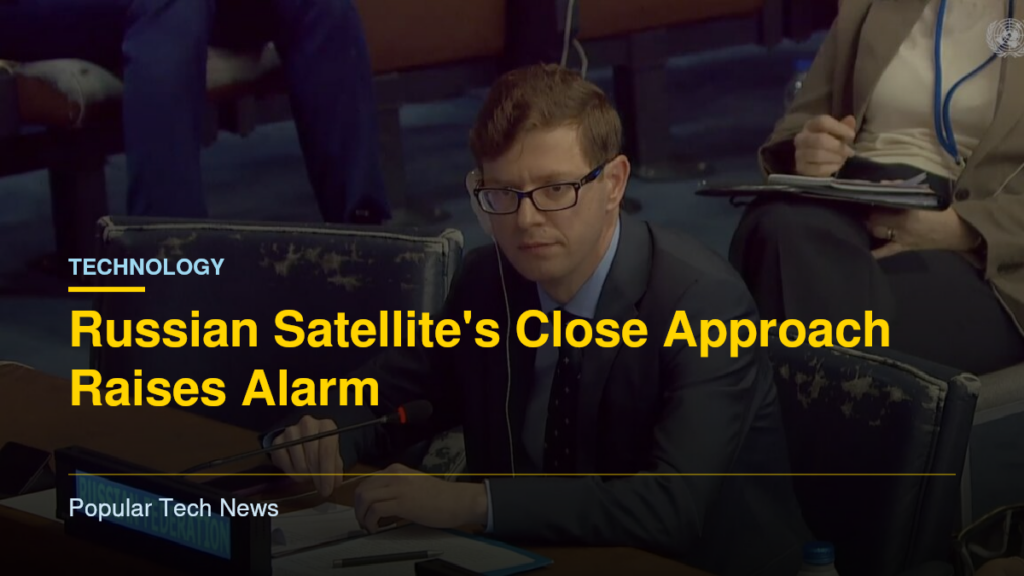
Brian Hardesty, a US State Department official, told the committee that the decision to conduct the activities was "deliberately reckless" and violated long-established safety thresholds in low-Earth orbit. Thomas DiNanno, the US Under Secretary of State for Arms Control and International Security, echoed the assessment on X. Konstantin Vorontsov, deputy head of Russia's delegation to the UN, dismissed the concerns as "unfounded" and accused Western countries of "loudspeaker diplomacy." All Russian activity in space is "purely peaceful in character," he said, including that related to Kosmos 2612. The incongruity is notable: four years ago, as Ukraine ramped up its use of commercial satellite communications and surveillance, Vorontsov said commercial space infrastructure used by Ukraine's military, including Western satellites, could be a "legitimate target for a retaliatory strike."
A History of Co-Orbital Tests
The maneuvers fit a pattern. Russia has conducted several tests in recent years of suspected anti-satellite weapons, including a system called Nivelir that can fire a projectile at high speed to smash into another object in orbit. Co-orbital ASAT experiments date back to the Soviet era. Taylor argued that observable behavior is hard to deny regardless of official statements: "What you do up there speaks much louder than what you say down here." The United States, Russia, China and India have all previously tested ground-launched anti-satellite missiles. In September, Air Force Secretary Troy Meink acknowledged for the first time that the US military possesses space-based weapons, without disclosing details, making the US government the first to admit placing weapons in orbit. China has demonstrated a Fractional Orbital Bombardment System and robotic arms and highly maneuverable satellites that could support servicing, inspection or capture of an adversary's spacecraft.
The Verification Problem
The UN discussion also focused on proposals by Russia and China for an international agreement banning the placement of any weapons in space. US officials call such blanket bans ineffectual and unrealistic, arguing they would inevitably be violated by their proponents while interfering with defensive capabilities. Hardesty said the world's leading space powers already possess such weapons, making the proposals moot. The deeper difficulty is definitional: ramming and jamming can be performed by conventional technologies carried on many kinds of satellites, so distinguishing a weapon from a maneuverable spacecraft is often a matter of intent rather than hardware. The United States instead points to the 1967 Outer Space Treaty, which bans weapons of mass destruction in orbit. In 2024, Washington proposed a Security Council resolution reaffirming that ban after a US intelligence leak suggested Russia was developing a nuclear-armed anti-satellite weapon; Russia vetoed it.
Why It Matters on the Ground
The encounter matters beyond arms control. Satellites like the ICEYE platform provide overhead imaging that supports Ukraine's efforts to target Russian battlefield forces and strike deeper into Russian territory. The episode coincides with a slowdown in SpaceX's Starlink and Starshield broadband service in Ukraine, affecting the country's use of satellite connectivity for drone operations, after President Trump and Elon Musk criticized Ukraine for attacking Russian diesel refineries. The Russian approach to ICEYE-X36 therefore lands at the intersection of commercial remote sensing, military targeting and the fragile norms that govern how close satellites may come to one another. The US accusation is currently supported by tracking data and imagery rather than any public evidence of a weapon, and corroboration of what Kosmos 2612 actually carries will be the test that determines whether the incident becomes a precedent or a warning.