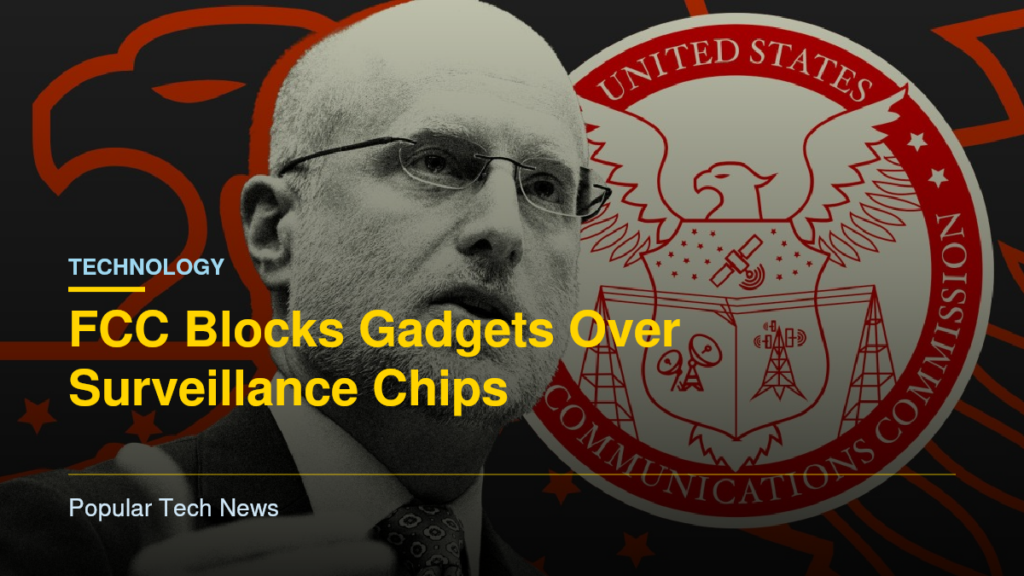
The Federal Communications Commission has blocked two consumer gadgets from the US market, citing the presence of what it calls a "foreign surveillance chip." The move, announced on October 22, is the first time the agency has exercised a power it granted itself just nine days earlier, on October 13, allowing it to bar any device containing a computer chip made by a company on its national security threat list.
A Loophole in the Covered List
The chip at the center of the action is the HiVision Hi3516CV610 UHD Smart Vision SoC, a system-on-chip that converts raw camera sensor data into usable video for devices such as home security cameras and dashcams. HiVision is a subsidiary of Huawei, which the US government has long treated as a national security risk and which appears on the FCC's Covered List. The FCC's new authority is designed to prevent companies from sidestepping that list by embedding banned components inside products sold under another brand's name.
The FCC justified its designation by pointing to HiVision's own marketing, which describes the chip as "designed for the surveillance market" and highlights built-in detection algorithms for human faces. The agency did not identify the two specific products it blocked, and it did not immediately respond to requests for comment.
What the Chip Actually Does
The Hi3516CV610 is a smart vision SoC, a class of component that handles image processing, video encoding and, in this case, on-device detection workloads. It is commonly sold as a bundle with a Sony camera sensor and sometimes with a lens already attached, according to product listings on AliExpress. That packaging model makes it easy for device makers to build a camera product around a single module without disclosing the provenance of the silicon inside.
For hardware developers, the case illustrates a growing compliance burden: component-level provenance now matters as much as the brand on the box. A camera, router or connected appliance assembled from off-the-shelf modules can be pulled from the US market if any constituent chip traces back to a covered entity, even when the finished product carries an unrelated label.
The FCC's Expanding Toolkit
The October 13 rule is the latest in a series of self-granted powers at the commission under Chairman Brendan Carr. The FCC has previously given itself the ability to retroactively ban gadgets already on the market and to block modular radio transmitters, extending its reach from finished devices down to the subcomponents that make them work. The agency has also moved against routers and, in a notable case, against the Roomba robot vacuum.
Each expansion has been framed as closing a gap in enforcement of the Covered List, which names equipment and vendors deemed unacceptable risks to US networks and supply chains. The HiVision action targets the same gap at the chip level: a covered company's silicon shipped inside a non-covered company's hardware.
Enforcement Questions Remain
The practical effect of the block is limited to two unnamed devices, but its significance is procedural. The FCC has now demonstrated that it will act on chip-level provenance, and the precedent could reach any product category where covered silicon appears. The agency has not published a list of affected chips beyond the HiVision part, leaving manufacturers to audit their own bills of materials.
Critics have questioned whether such actions genuinely improve security or instead pick winners and losers in the market while creating the appearance of enforcement. The FCC has declined repeated requests to discuss its approach in detail. For now, the burden falls on device makers and importers to verify that the components inside their products do not originate from companies on the Covered List, a task that grows harder as supply chains become more layered.