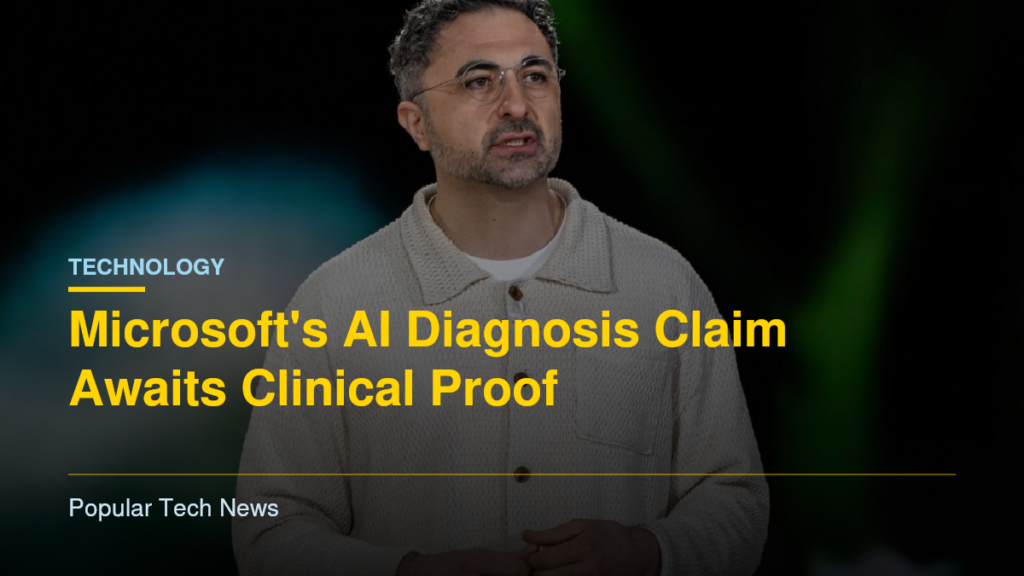
Microsoft has published peer-reviewed research in Science claiming that its AI system, the Diagnostic Orchestrator, can diagnose medical conditions far more accurately than human physicians. On cases drawn from hundreds of case reports in The New England Journal of Medicine, the system reached roughly 83 percent diagnostic accuracy, compared with about 36 percent for generalist physicians who had references available and 22 percent for those working without them. On emergency department cases from a patient admissions database at Beth Israel Deaconess Medical Center in Boston, the system scored 80 percent against an average of 47 percent for human doctors. The company frames the result as a step toward what it calls "medical superintelligence."
How the Diagnostic Orchestrator works
The system is not a single model answering a question. It is built as a panel of multiple AI agents that reason through symptoms and medical histories, decide which tests to order, and converge on a diagnosis, imitating the investigative process clinicians use. Microsoft built its own benchmark, SDBench, from the case material and says it plans to open-source it. The Orchestrator runs on OpenAI's GPT-5, and the researchers report it outperformed frontier models operating alone. The paper does not include newer models such as GPT-6 Astra, Meta's Muse Wonder Full, Google's Gemini 4 Argon, or Anthropic's Opus 5.5. The system was first developed when GPT-4.1 was the most advanced model available, but the team says later testing suggests that gains in individual model capability do not necessarily reduce the benefit of coordinating multiple agents. The AI also tended to reach diagnoses at a lower estimated cost than its human counterparts.
The caveats Microsoft acknowledges
The tests were retrospective, built from past cases rather than live patients, and Microsoft concedes it is unknown how the system would perform in real clinical settings. Mustafa Suleyman, CEO of Microsoft AI, told The Verge that the tool "needs clinical validation" and described the result as a major milestone rather than a finished product. Dr. Dominic King, Microsoft's AI health lead and a coauthor of the study, said the company plans to begin testing the system in hospital settings with Beth Israel Deaconess Medical Center, likely within the next couple of months. Neither executive would commit to a firm timeline for broader deployment, and Microsoft has not said when or how the technology might be commercialized. King pointed to the heavy regulatory and compliance requirements in medicine as a reason for a cautious rollout.
A broader health ambition
Diagnosis is only one part of Microsoft's plan. In a blog post and an article in the BMJ Digital Health & AI journal published the same day, the company outlined five other areas it believes AI must master, including coordinating clinical care, making treatment decisions, and handling the human side of medicine. Microsoft has used the term "superintelligence" since before it became a political catch-all for AI. Suleyman predicted that within the next couple of years the company will build something "indistinguishable from human performance" on medical tasks, and that next year will bring "extremely impressive deployments of intelligent systems in production." He insists clinicians will retain a central role, with AI absorbing what he calls the drudgery of medicine so doctors can spend more time with patients.
What the evidence still needs
The headline numbers are striking, but the comparison is not a clinical trial. Physician accuracy in the study reflects performance on written case scenarios with and without references, not the iterative, test-driven workup of a real patient who can deteriorate, withhold information, or present with ambiguous symptoms. A system that orders tests and reasons across agents also raises questions about cost, false positives, and accountability when a recommendation is wrong. The open-sourcing of SDBench is a meaningful step because it lets outside researchers probe the benchmark for leakage and construct validity. The hospital pilot with Beth Israel Deaconess will be the first real test of whether the Orchestrator's advantage survives contact with live clinical workflows, electronic health records, and the messy data of actual care. Until those results are published, the claim that AI is better than doctors at diagnosis remains a benchmark result awaiting clinical proof.