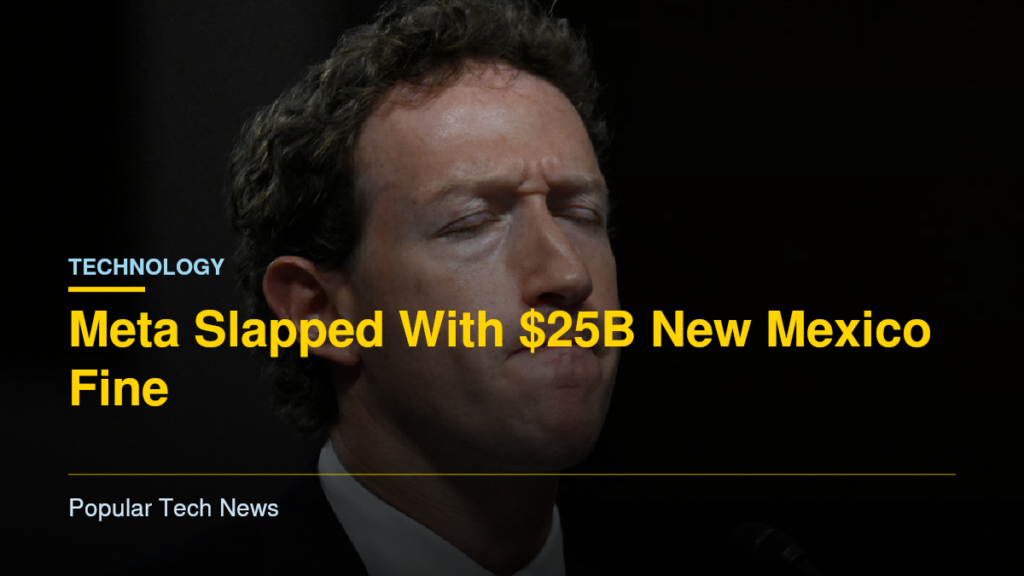
Meta has been ordered to pay $25 billion to New Mexico after a jury found the company liable for nearly 44 million violations of state consumer protection laws, the largest penalty ever levied against the social media giant. The ruling, issued Wednesday by US district court judge Francis J. Mathew, followed New Mexico Attorney General Raúl Torrez's decision to take the case to trial rather than join an $18 billion multistate settlement Meta reached earlier this year with attorneys general in nearly every other state.
A Decade of Deception
Mathew's opinion painted a damning picture of Meta's conduct stretching back to 2010, when the company was still known as Facebook. The jury found that Meta repeatedly misled users about their control over personal data, third-party data misuse, misinformation, hate speech, and equal enforcement of platform rules. The judge noted there was no "bright line rule" for setting the penalty, but concluded that the trial record—including evidence that top leadership, including Mark Zuckerberg, knew the company was making misleading public representations—supported "the highest level of penalty allowed by the NM Unfair Practices Act."
"The jury was unequivocal: Facebook systematically misled the public" and "took advantage of the public's lack of knowledge respecting Facebook's practices to a grossly unfair degree," Mathew wrote. He pointed to internal messages showing Zuckerberg laying out a plan to deceive users about privacy settings: "Give them a chance to change their privacy settings but obviously don't encourage it." The court also found that Meta failed to notify users when third-party apps misused their data, flagging only two of 2,000 unique apps associated with data misuse, and that the company deliberately narrowed its internal definition of data misuse to avoid the operational burden of notifying affected users.
Why New Mexico Went It Alone
New Mexico had asked the court for penalties as high as $40 billion, arguing that the entire state's population of 2 million people was harmed by Meta's conduct and that anything less might not meaningfully change the company's behavior. Meta, by contrast, had hoped the penalty would align with the $5 billion settlement it reached with the Federal Trade Commission over the Cambridge Analytica scandal, and argued that anything above $3.4 billion would be unconstitutional. Mathew rejected that comparison, writing that the FTC settlement "cannot be viewed in a vacuum" and that prior penalties and consent agreements "have not deterred Meta from using deceptive trade practices."
Torrez celebrated the ruling as "a historic day for New Mexico and for consumers across the country." He said the case was about whether corporations can mislead consumers about what happens to their personal information without facing meaningful consequences. "We took on one of the largest companies in the world because New Mexicans deserve honesty, accountability, and the protection of their personal information," Torrez said.
Meta Vows to Appeal
A Meta spokesperson confirmed the company plans to appeal, arguing that the ruling and the attorney general's enforcement approach make it "all but impossible to do business in the state of New Mexico." The company also framed the lawsuit as an attempt "to impose a tax on speech to enforce new rules for what people can say online." Legal experts told Reuters that Meta has a reasonable chance of reducing the fine on appeal based on constitutional claims.
The penalty lands as Meta absorbs the cost of the multistate settlement. The company's third-quarter earnings report showed it paid close to $10 billion toward that $18 billion agreement; without that expense, income from operations would have been $22 billion higher. The fine also arrives as Meta attempts to reboot its struggling AI strategy, and the company's statement appeared to nod to its AI ambitions—and to the Trump administration—by emphasizing its role in helping "the country maintain its competitive edge."
Wider Implications for AI and Data Enforcement
Consumer advocates see the New Mexico ruling as a template for holding large platforms accountable. Nidhi Hegde, executive director of the American Economic Liberties Project, told AP News that users want more enforcers willing to take companies to trial rather than settle. She warned that as Meta and others roll out AI products—pointing to its Muse AI assistant, which encourages users to trust it with everything from bank accounts to medical information—state oversight will become more critical. "We need more enforcers with courage and laws with actual teeth to rein them in," Hegde said.
Torrez vowed to keep watching Meta and to use the case as a blueprint for enforcing consumer protection laws against tech giants. "This case has always been about more than one company or one scandal," he said. "It is about whether corporations can mislead consumers about what happens to their personal information without facing meaningful consequences."