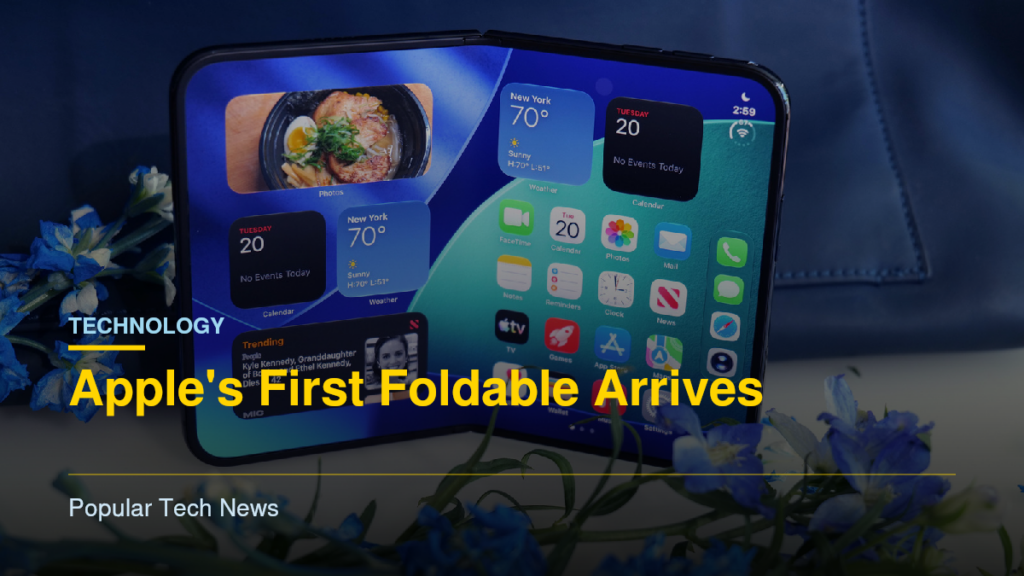
Apple has entered the foldable market with the iPhone Duo, a $1,999 device that marks the company's first foray into bendable smartphones. A review of the device describes it as a first-class foldable, albeit one that arrives years after Android rivals and carries some familiar growing pains. For a technology audience, the Duo is significant not just as a new product category for Apple, but as a test of how the company's tightly controlled hardware and software ecosystem adapts to a form factor that demands flexibility from both.
Design and Displays
The iPhone Duo features two OLED panels: a 5.4-inch exterior display with a resolution of 1,878 x 2,670 and 120Hz ProMotion, and a 7.6-inch interior display at 1,398 x 2,034. Both offer peak brightness up to 3,000 nits, and the matching aspect ratio ensures a smooth transition between screens. The inner screen uses a matte nanotexture finish that reduces reflections and helps conceal the crease, though a slight divot remains visible at certain angles. That nanotexture layer is replaceable for a $49 fee, but it can be peeled off if picked at—and unlike Android competitors, there's no setup warning against doing so.
The device is held together by a titanium chassis and a hinge composed of more than 100 components, which can hold the phone open in a wide range of positions. Notably, the Duo carries an IP68 rating for dust and water resistance, a feature only otherwise available on the Pixel 11 Pro Fold line in the US. Instead of Face ID, Apple opted for a Touch ID sensor in the lock button, a decision the company says provides a more consistent experience across different holding positions.
The main trade-off is weight: at 254 grams (8.96 ounces), the Duo is more than 25 percent heavier than a Galaxy Z Fold 8, despite having fewer cameras and smaller displays. That bulk makes it feel like an anchor in loose pockets and encourages two-handed use during longer sessions.
Performance and Software
Powered by the A20 Pro chip—the same silicon found in the iPhone 18 Pro—the Duo delivers strong performance for gaming and multitasking. Users can run multiple apps side-by-side, and the device even supports running two games simultaneously. Multitasking is handled through gestures: long-pressing an app summons a split-view option, and swiping up and holding allows dragging apps to either side. Pairs of apps can be pinned together for quick access.
iOS 27 introduces significant UI changes for the wider displays, moving the home app row to the side and relocating status icons to the top right corner. First-party apps like the App Store and Contacts have been optimized with dual-pane designs, and the phone supports half-closed positions for photography or video watching. However, many third-party apps remain unoptimized. Telegram, for example, opens in portrait orientation with dead space on either side, and games like Sword of Convallaria suffer from letterboxing. While apps such as Netflix, Instagram, and OpenTable have been updated, the gap between optimized and unoptimized software is the biggest growing pain.
Cameras
The Duo's rear camera setup consists of dual 48-megapixel sensors offering 2x optical zoom and two focal lengths (26mm primary and 13mm ultra-wide). A 12MP Center Stage camera sits on the exterior display for selfies and video calls. In side-by-side testing against a Galaxy Z Fold 8, the Duo held its own, and in low-light conditions it produced more well-exposed images with accurate colors. It supports 4K video at up to 120fps and adjustable Photographic Styles. A standout feature is the under-display camera hidden beneath the main screen, achieved by altering the sub-pixel layout to let light through without leaving a visible black dot.
The Verdict
The iPhone Duo earns an 8.8/10 rating, praised for its slick design, strong performance and battery life, nanotextured main display, IP68 rating, and camera quality. It is criticized for being heavy, expensive, having only two rear cameras, and—most significantly—the lack of app optimization. For developers, the message is clear: Apple's foldable is here, and the opportunity to build adaptive interfaces for it is wide open.