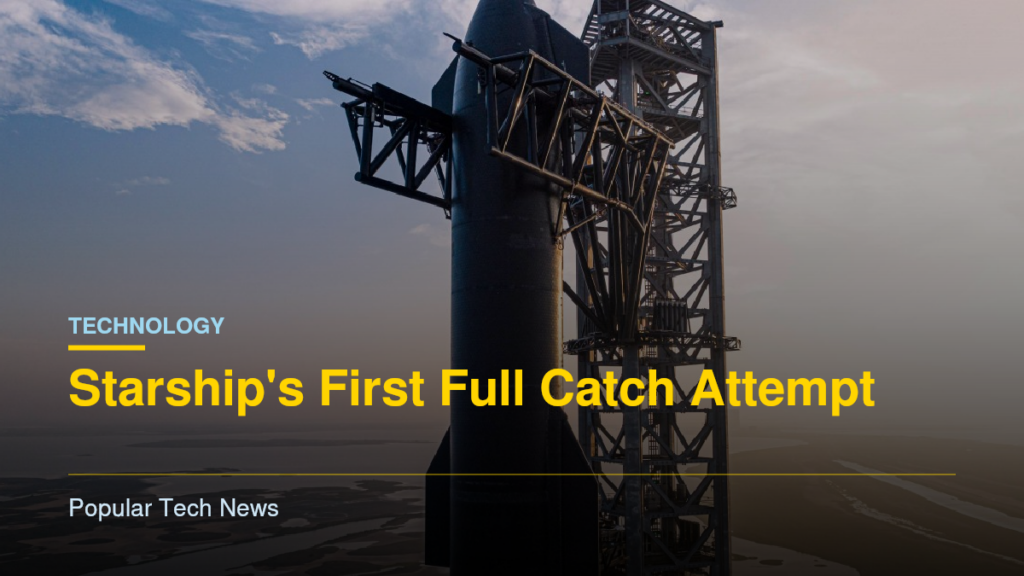
SpaceX will attempt to catch both the Starship upper stage and its Super Heavy booster on the next flight, CEO Elon Musk said during the company's third-quarter earnings report on Tuesday, setting up a test that would mark the first time an orbital launch vehicle has been fully recovered. The attempt is planned for next month, and Musk framed it as a defining moment for the program.
A Full-System Recovery Attempt
Starship is a two-stage system: the Super Heavy booster as the first stage and the Starship spacecraft as the second. The stack stands roughly 120 meters (about 400 feet) tall with a 9-meter diameter and is powered by SpaceX's Raptor engines, which burn liquid methane and liquid oxygen. The vehicle, first introduced in 2018, was designed to return to the launch site, where launch towers equipped with mechanical "chopstick" arms catch it mid-air. Catching both stages on a single flight would close the loop on full reusability, a step beyond recovering only the booster or splashing down in the ocean.
Musk described the milestone in expansive terms, calling it "a profound technology milestone in the history of civilization consciousness." He also acknowledged the risk. "Success is not guaranteed on these first flights, but I'd say it's more likely than not that this succeeds next flight," he said, adding that a steady stream of Starship flight attempts is planned through the end of this year and will accelerate next year.
The Preceding Flight and Its Setbacks
Last month's Starship launch notched two firsts for the next-generation rocket: it sent the spacecraft into Earth orbit and inserted a few dozen of SpaceX's larger, more capable V3 satellites into the Starlink constellation for the first time. The mission did not go entirely to plan. One Raptor engine shut down prematurely during ascent, forcing mission control to adapt and complete the climb on the remaining engines. Because of that issue, SpaceX cut the planned 10-hour, six-orbit mission short after about three hours and two Earth orbits.
The Super Heavy booster splashed down in the Gulf of Mexico, while the Starship upper stage performed a de-orbit burn and ended in a fiery vertical splashdown in the Pacific Ocean north of Hawaii. Neither piece was recovered. The upcoming catch attempt therefore represents a shift from controlled water landings to hardware recovery at the launch site, the approach the vehicle was designed around from the outset.
Engineering Significance
For the engineering community, the catch maneuver is the hard part of the reusability story. Returning a booster to a tower and capturing it with arms demands precise terminal guidance, throttle control and structural margins that ocean splashdowns do not exercise. Extending that to the Starship upper stage compounds the challenge, since the second stage arrives from orbital velocity and must survive reentry before making a controlled descent to the catch point. A successful double catch would validate the architecture SpaceX has bet on for rapid turnaround and high flight cadence.
Musk's comments also tie the technical milestone to the company's broader business. The V3 Starlink satellites deployed on the previous flight point to Starship's role as a heavy-lift delivery system for the constellation, and a reliable, fully recoverable vehicle is central to that plan. The earnings call setting placed the catch attempt alongside SpaceX's commercial reporting, underscoring how closely the launch system's progress is tied to the company's operational and financial outlook.
The next flight will test whether the chopstick towers can do for the full stack what they have done for the booster alone. Musk's own estimate puts the odds in favor of success, but the program's history of iterative testing means the result will be watched closely either way. SpaceX has scheduled further attempts through the rest of the year, so even a missed catch would feed directly into the next launch.