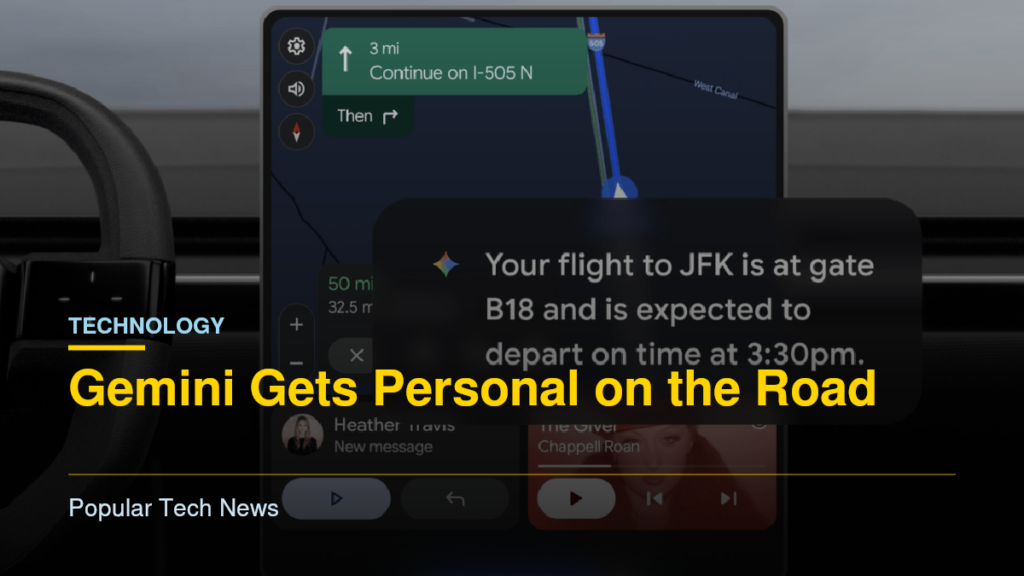
Google is extending its Personal Intelligence feature to Gemini in the car, allowing the assistant to draw on a driver's data across Google apps while on the road. The update covers Gemini in Android Auto and vehicles with Google built-in, and lets the assistant reference information from Gmail, Calendar, Maps, Photos, YouTube and Search. The company detailed the rollout on Tuesday, with Personal Intelligence reaching Android Auto immediately and cars with Google built-in following in the coming months.
What the assistant can now do
The practical effect is that drivers can issue requests that depend on personal context rather than explicit input. Google's examples include asking Gemini about a flight status while driving to the airport, where the assistant pulls the flight details from a confirmation email in Gmail and then looks up the current status. A driver can also say "take me to my doctor's appointment" instead of entering an address, or ask Gemini to "find the car wash from the photo I took last week and navigate there." Each of those requests chains together a personal data source, a lookup and an in-car action, which is a meaningfully more complex pipeline than the voice commands Android Auto has historically supported.
The privacy controls built around it
Google says the feature is gated behind an opt-in. Gemini will connect to a user's apps only if the Personal Intelligence setting is enabled, and personalized responses are shared only when a phone is connected to the car. That second condition matters: the personalization layer appears to depend on the phone as the source of account context rather than residing solely in the vehicle's head unit. Google also states that declining the feature does not degrade the core in-car experience. Without Personal Intelligence, navigation, music playback, calls and general questions all continue to work, but the answers will not be tailored to the individual.
Why the car is a harder environment
The rollout lands at an awkward intersection of convenience and risk. In a vehicle, the user's attention is divided, so the value of a single natural-language request that replaces several taps is high. The same constraint makes errors more costly. A misread destination pulled from a photo, or a stale calendar entry, becomes a navigation instruction delivered at speed. Google's design puts the burden on the user to confirm the setting and to keep a phone connected, which gives the company a clear consent boundary and a way to scope where personal data is processed. For developers and IT administrators who manage fleets or company vehicles, the phone-connection requirement also creates a practical policy question: whose account is linked, and what data leaves the device when an employee's phone pairs with a shared car.
A platform that keeps expanding
Gemini arrived in Android Auto last year and reached cars with Google built-in in April. Several automakers, including Ford, GM, Honda, Nissan, Volvo and Polestar, have shipped newer vehicles with Google built-in, which supports native Android apps rather than relying entirely on a tethered phone. Personal Intelligence pushes that platform further toward an assistant that behaves like a persistent agent across services, and the staged rollout suggests Google is treating the phone-tethered Android Auto path as the first proving ground before extending the same context to embedded vehicle systems.
What to watch
The near-term questions are how transparently the assistant signals when it is using personal data, how users revoke access, and whether the phone dependency holds up in vehicles where the head unit has its own connectivity. Google has set the consent model and the rollout sequence; the reception will depend on whether drivers find the trade of context for convenience worth making, and whether the answers are accurate enough to trust while the road demands attention.