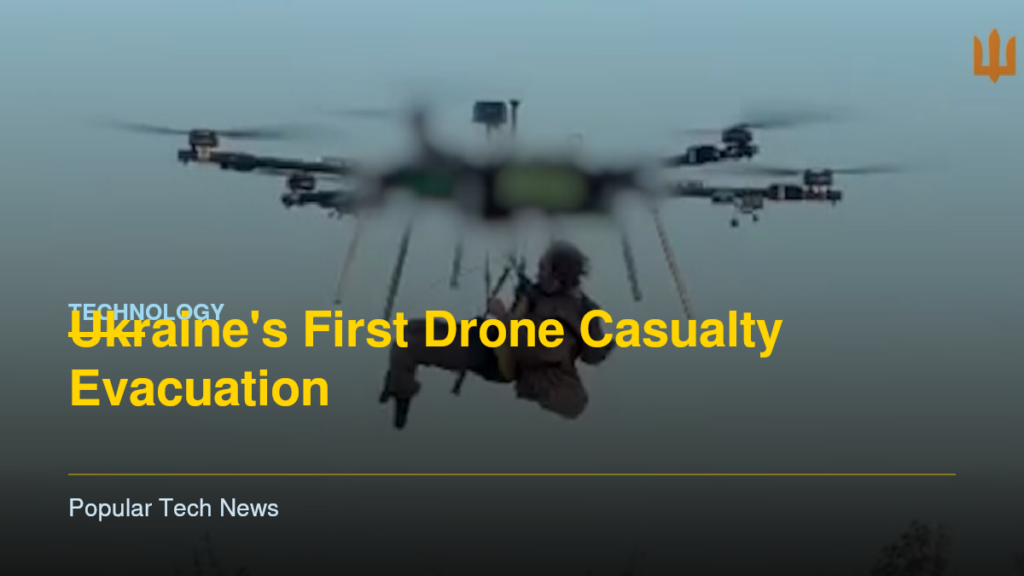
Ukraine has carried out what appears to be the first battlefield evacuation of a wounded soldier by drone, airlifting a casualty out of a frontline position using a heavy six-rotor aircraft. The operation, revealed on October 19 when Ukraine's Army shared video of the flight, converts a concept the US military has studied for decades into an operational reality — and does so under the threat of Russian drones and landmines that ruled out the usual alternative of a wheeled ground robot.
How the evacuation worked
The rescue was performed by the 92nd separate assault brigade's unmanned ground systems company, using a Heavy Shot AYUDAG 6 hexacopter supplied free of charge by Ukrainian manufacturer Gurzuf Defence. According to the company's account, special carabiners were first flown out to the wounded soldier so he could attach himself to the drone, which was fitted with a winch. Video of the operation shows the soldier securing himself in a harness suspended beneath the aircraft before being flown to safety.
The flight took 1 hour and 14 minutes from start to finish and covered nearly 39 miles (62 kilometers). The hexacopter is reported to be capable of carrying up to 200 pounds (90 kilograms). The soldier, who serves with Ukraine's 30th separate mechanized brigade, had spent almost 500 days at a frontline position under threat of Russian fire, relying — like many troops in forward positions — on friendly drones for ammunition and other supplies.
A historic first, with caveats
"This is a historic event, the next stage of evacuating the wounded, which we will all come to," said a programmer of the 92nd brigade who goes by the callsign Napalm, in line with Ukrainian military practice. "Now the serious systematic work begins, so that such missions are carried out constantly."
Gurzuf Defence cofounder Pavlo Feldblium cautioned that the technique carries real risk for the wounded and should be treated as a last resort. The trade-off is nonetheless significant: heavy drones offer faster evacuation and potentially better survivability than waiting for a ground vehicle, and they keep human rescuers out of harm's way by putting the mission in the hands of pilots operating remotely from positions farther back. Ground robots, by contrast, can take hours to cross rough terrain and are themselves vulnerable to enemy drones.
A wider Ukrainian drone ecosystem
The evacuation comes barely a week after a separate Ukrainian manufacturer, SkyFall, unveiled its own StarGate hexacopter, purpose-built with a stretcher-based container for carrying wounded soldiers. That aircraft was sent to a Ukrainian brigade for frontline testing beginning in October. It relies in part on Starlink satellite communications but carries a proprietary backup link — useful given recent throttling of US-provided Starlink services in Ukraine — and an onboard AI system that can guide the drone back to a safe area if all communications are lost.
Lessons for the Pentagon
The development is a pointed data point for the US military, which has spent decades developing and testing uncrewed aircraft for casualty evacuation without putting them into operation. American forces have generally operated where they hold advantages in air superiority and surveillance, making crewed medical evacuations safer; the US still relies primarily on crewed helicopters for the task, though the Navy sent a drone boat to help rescue downed aviators near the Strait of Hormuz in June 2026.
Ukraine's battlefield has been far less forgiving. Enemy drone surveillance and strikes make rescue operations hazardous, and wounded soldiers often remain stranded at forward positions for long periods. Writing for War on the Rocks, Kai Gilmour Gath — a former British Army and Ukrainian Armed Forces reconnaissance operator who served in the contested Donetsk region — noted that many wounded soldiers in Ukraine end up dying or listed as missing in action.
Against that backdrop, the 92nd brigade's flight is less a demonstration than a template. The engineering questions now shift from feasibility to reliability: winch and harness designs that work under fire, communications links that survive jamming and throttling, and autonomy that can complete a casualty run when the pilot's signal does not.