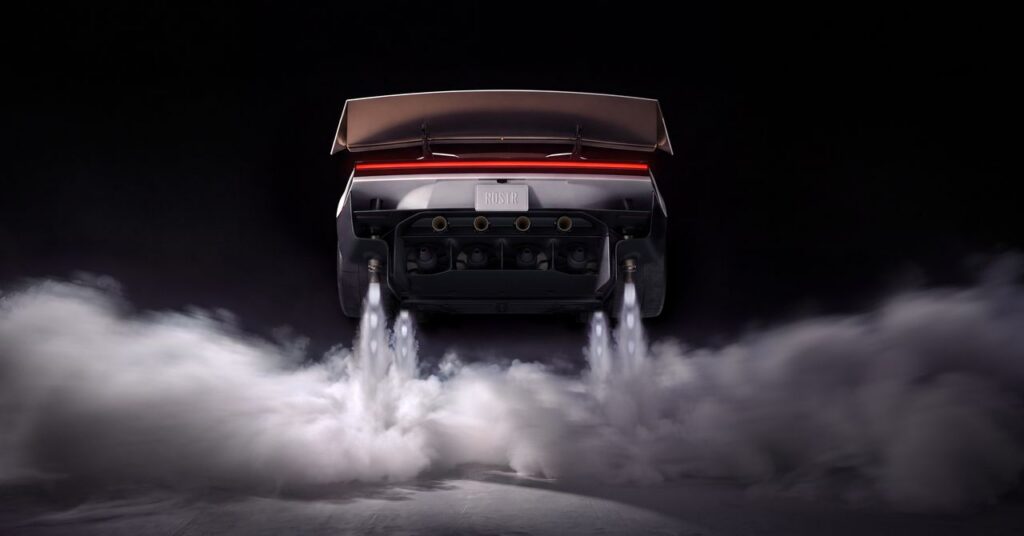
Tesla CEO Elon Musk unveiled the long-delayed Roadster 2 at SpaceX's rocket development facility in McGregor, Texas, with a showmanship-heavy demonstration that saw the two-seater prototype launch over the automaker's lineup, accelerate from 0 to 60 mph in under a second, and drive upside down on a high ramp before flipping midair and landing with the aid of onboard thrusters. While the spectacle generated viral social clips, Tesla's stock price slipped after the event, and the claims behind the car's gravity-defying performance deserve closer scrutiny.
The Engineering Behind the Stunt
According to Tesla vehicle engineering head Lars Moravy, who detailed the Roadster 2's systems to Hagerty ahead of the event, the car's tricks rely on two distinct technologies: a suction system and cold gas thrusters. The suction system uses four 20-kilowatt fans and four independent replaceable skirts that drop down to create low pressure underneath the car, effectively sticking it to the road at lower speeds where aerodynamic wings are not yet generating downforce. Moravy claims this "sucker system" can produce over 2 g's in a corner even below 50 mph. A similar approach appears on the McMurtry Spéirling Pure, which uses two high-speed electric fans to generate up to 2,000 kg of downforce, suggesting the concept is not entirely novel.
The "SpaceX system," developed with Musk's aerospace company, uses cold gas thrusters that expel pressurized nitrogen to generate thrust—a technology primarily used for spacecraft stabilization. Behind the seats sits a 200-liter carbon-overwrapped pressure vessel holding up to 10,000 PSI. For the "flight system," an additional 400-liter tank occupies the passenger seat, making the car a single-seater, and six extra thrusters are added: one in each corner plus two at the front for yaw control. In launch mode, Moravy says the rear thrusters produce more than 80 kilonewtons of thrust, matching the Dassault Falcon 10X jet, and the car can hit 0 to 60 mph in under a second while subjecting the driver to up to 5 g's.
Performance Claims and Caveats
The Roadster 2 will be rear-wheel-drive only, a departure from Tesla's recent all-wheel-drive EVs. Two motors deliver over a megawatt of power (1,341 horsepower) and more than 1,400 Nm of torque—figures that exceed the three-motor Plaid—but all of that power goes through just the rear wheels. Moravy says the car weighs "just under 1,700 kilos," not significantly heavier than the original 1,300-kg Roadster despite its larger size. Tesla claims a range of over 300 miles and says the battery can charge from 15 to 80 percent in 10 minutes. The Performance model will feature the sucker system without thrusters, achieving 0 to 60 in 1.6 seconds and a top speed of 210 mph, while the Thrust model gets the full package and a 230-mph top speed.
However, the "flight system" has a fundamental limitation: unlike in space, where cold gas thrusters provide consistent thrust until fuel depletion, on Earth the system loses thrust as the compressed gas runs out. Moravy likens it to a balloon losing air. Refilling the 600-liter nitrogen tanks currently takes six to seven hours, though Tesla says it is working on a system to reduce that to 30 minutes.
Production Timeline and Regulatory Hurdles
Tesla says production won't begin until 2028, and current prototypes are being used for further development. That timeline warrants skepticism: Musk previously promised Roadster deliveries would begin in 2020. Moreover, the Federal Aviation Administration's response to a "flying" car remains an open question. For now, Tesla has opened a reservation page: a $5,000 fee secures the Performance variant, with an additional $45,000 due within 10 days, while the Thrust model requires $5,000 initially and $245,000 within 10 days.
The demonstration was undeniably impressive as theater, but the engineering claims—particularly the sub-second acceleration, the 230-mph top speed, and the viability of thruster-based flight—remain unverified by independent testing. Until production models reach customers and regulators weigh in, the Roadster 2's most extraordinary feats should be viewed as prototype stunts rather than proven capabilities.