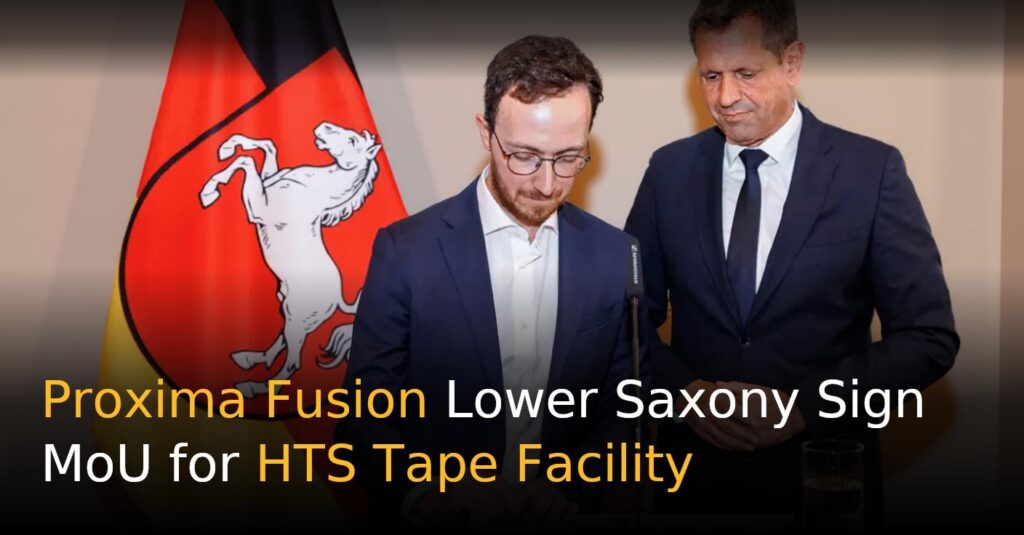
Proxima Fusion and the German state of Lower Saxony signed a Memorandum of Understanding on 9 September 2026 in Hanover, setting the groundwork for industrial-scale manufacturing of high-temperature superconducting (HTS) tape in Lower Saxony — the first production facility of its kind in Germany and Europe.
Key takeaways
- The MoU targets Europe’s first industrial-scale HTS tape production plant, located in Lower Saxony.
- Roughly €140 million is planned for the first two phases through the end of 2029, split equally between public and private funding.
- Lower Saxony intends to contribute €21 million, just under 30% of the proposed public funding share.
- Proxima Fusion will be the anchor customer, requiring about 20,000 km of HTS tape for its Alpha demonstrator and a further 40,000 km for the Stellaris power plant.
- HTS tape is currently manufactured at industrial scale primarily in Asia, making domestic European capacity strategically important.
Why HTS tape is a strategic technology
HTS tape is a specialized metallic tape that achieves superconductivity at comparatively elevated temperatures. In its superconducting state, it can transmit electrical currents with almost no resistive losses. That near-lossless current-carrying capability enables electromagnets that are both exceptionally powerful and compact.
Those magnets are essential components of stellarators, generating the magnetic fields that confine and control the extremely hot plasma inside a fusion machine. HTS tape is therefore a key enabling technology for fusion: by allowing more compact and powerful fusion machines, it supports both the technical realization of fusion energy and the development of cost-effective power plants.
The planned facility and its funding
At present, HTS tape is manufactured at industrial scale primarily in Asia. The planned Lower Saxony site would be the first of its kind in Germany and Europe, establishing domestic production capacity that is strategically important if the stellarator supply chain is to be located almost entirely within Europe.
The plant is expected to generate industrial value and highly skilled employment while forming a foundational industrial base for new European supply chains. Approximately €140 million in investment is planned for the first two phases of the project, which extend through the end of 2029, divided equally between public and private funding sources. The State of Lower Saxony intends to contribute €21 million, representing just under 30% of the proposed public funding contribution. Proxima aims to finance the total investment equally through private capital and public funding.
| Investment element |
Detail |
| First two phases |
Approximately €140 million through the end of 2029 |
| Public/private split |
Divided equally between public and private funding sources |
| Lower Saxony contribution |
€21 million, just under 30% of the proposed public funding contribution |
| Proxima financing aim |
Equal private capital and public funding for the total investment |
Demand from Alpha and Stellaris
Proxima Fusion will serve as the anchor customer for the HTS tape produced at the facility. Under current plans, Proxima will require approximately 20,000 kilometres of HTS tape for Alpha, its fusion demonstrator, and a further 40,000 kilometres for Stellaris, its planned power plant.
Long-term purchase volumes will be critical to scaling production, retaining manufacturing expertise and reducing the cost per metre. The facility would establish an essential industrial foundation in Lower Saxony for Proxima’s Alpha fusion demonstrator, its planned Stellaris power plant and, ultimately, the production of stellarators at scale.
Beyond fusion: other applications
Beyond the stellarator supply chain, the HTS manufacturing capacity would also serve applications including high-performance electricity grids, medical imaging and treatment, advanced propulsion systems and other high-field magnet technologies.
By bringing together materials expertise, production processes, quality assurance, skilled workers and suppliers, the facility would create a critical upstream manufacturing capability with applications across a wide range of sectors while reducing dependence on overseas suppliers.
Building a European fusion supply chain
Proxima is in discussions with several international technology partners about bringing established HTS manufacturing expertise and production capabilities to Lower Saxony. Through the Alpha Alliance, more than 50 companies across Europe are already working to develop an industrial supply chain for fusion energy. The production of fusion-grade HTS tape adds a key component to this industrial base and closes a decisive gap in Europe’s fusion supply chain.
The plant enables Germany to retain manufacturing expertise and economic value, make its European supply chains more resilient and translate its world-leading stellarator research into an internationally significant industry.
What the MoU covers
Through the MoU, Lower Saxony and Proxima Fusion are creating a framework for translating this technological demand into an industrial production base. The agreement covers the assessment of potential sites in Lower Saxony, establishing a milestone-based support and funding structure, facilitating permitting processes, and developing partnerships with companies, municipalities and research institutions across the state.
Reaction from Lower Saxony and Proxima
Olaf Lies, Minister-President of Lower Saxony, said that Lower Saxony is being made a pioneer in European HTS manufacturing. He said this will not only support Germany’s ambitious fusion-energy goals, but also bring advanced manufacturing, new economic value, highly skilled jobs and technological expertise to the state, with the potential to generate positive innovation effects across many other industries. Lower Saxony will become, quite literally, a magnet for a new critical technology, he said.
Dr Francesco Sciortino, co-founder and CEO of Proxima Fusion, said that HTS tape is one of the critical technologies needed to scale fusion rapidly at an industrial level. He said Alpha and Stellaris will create the demand required to build this manufacturing expertise locally, and that Lower Saxony has the industrial base, energy expertise and political determination to turn a supply-chain dependency into an enduring strategic strength for Germany and Europe.
Falko Mohrs, Minister of Science and Culture, Lower Saxony, said that Lower Saxony offers excellent conditions for the industries of the future. He said the state’s research institutions have particular strengths in key fusion technologies, especially laser physics and photonics, and that the planned facility demonstrates the importance of collaboration between science and industry in developing new areas of strength for Lower Saxony.
Why it matters
HTS tape sits at the centre of Europe’s effort to build a sovereign fusion supply chain. With industrial-scale production currently concentrated in Asia, the Lower Saxony facility would give Germany and Europe domestic capacity for a technology used not only in stellarators but also in power grids, medical technology and advanced propulsion. The MoU ties a critical upstream manufacturing capability to the demand generated by Proxima Fusion‘s Alpha and Stellaris projects, while the Alpha Alliance’s more than 50 European companies provide the broader industrial base.
What happens next
The MoU sets out a framework for assessment of potential sites in Lower Saxony, a milestone-based support and funding structure, permitting facilitation and partnerships with companies, municipalities and research institutions. The first two phases of the project run through the end of 2029, with the €140 million investment split equally between public and private sources and Lower Saxony’s €21 million contribution representing just under 30% of the proposed public funding.