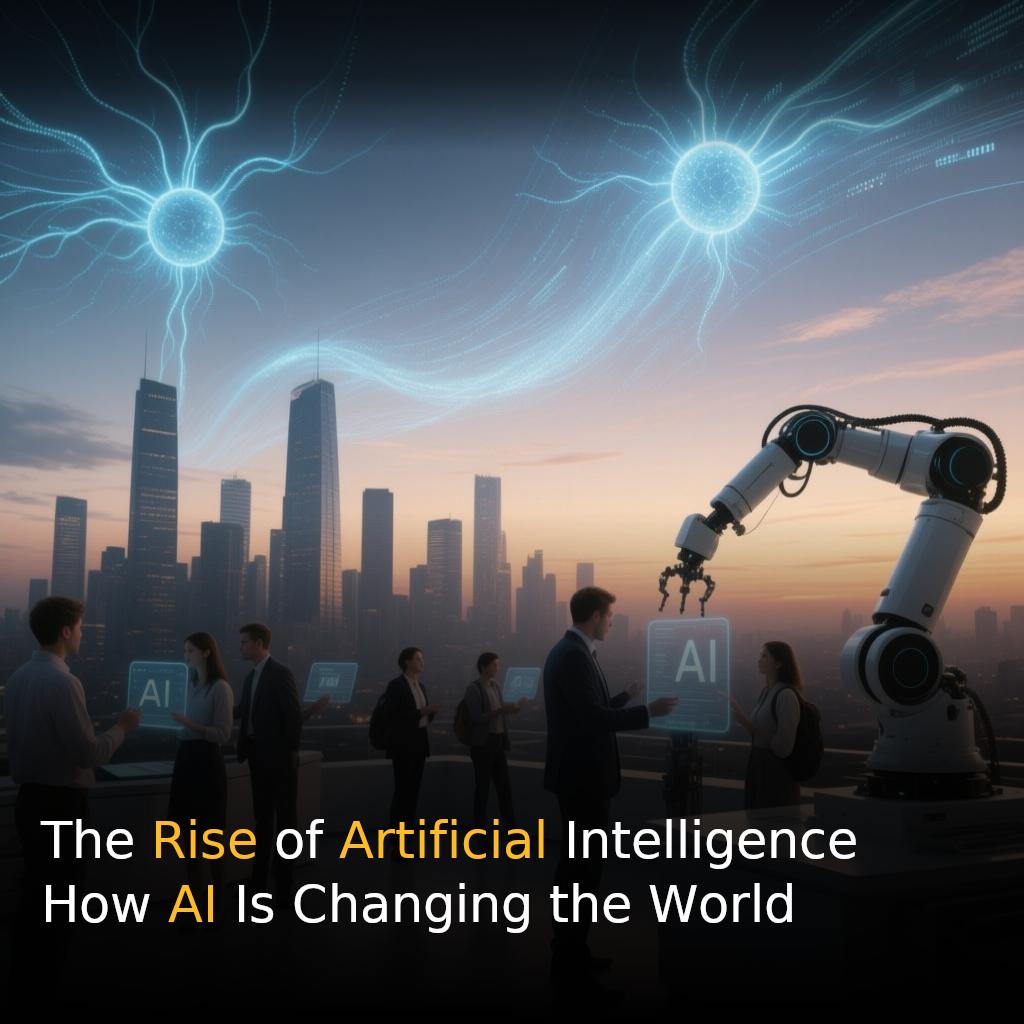
The rise of artificial intelligence has moved from theoretical research to a transformative force reshaping industries, economies, and daily life across the United States and Europe. From generative AI systems that create text, images, and code to AI agents that automate complex tasks and AI-powered robotics that operate in physical spaces, the technology is advancing at an unprecedented pace. This article explores how AI evolved from early concepts to today’s advanced systems, why adoption has accelerated, and what the future holds for businesses, workers, and society.
Key Takeaways
- AI has evolved from early symbolic reasoning and expert systems to modern generative AI, AI agents, and AI-powered robotics.
- Accelerated adoption is driven by increased computing power, vast data availability, and breakthroughs in deep learning and transformer architectures.
- AI is transforming businesses, jobs, education, healthcare, software development, robotics, and everyday life, creating major opportunities while posing significant risks.
- Risks include misinformation, job displacement, privacy and security concerns, bias, and overreliance on AI systems.
- Over the next decade, AI is expected to reshape society and the global economy, requiring proactive preparation from individuals and businesses.
What Happened: The AI Revolution Is Here
The rise of artificial intelligence represents one of the most significant technological shifts of the 21st century. What began as a niche academic field in the 1950s has grown into a multi-billion-dollar industry, with generative AI models like ChatGPT, Google’s Gemini, and Anthropic’s Claude capturing global attention. These systems can produce human-like text, generate realistic images, write code, and even assist in scientific research, signaling a new era of human-machine collaboration.
For readers in the United States and Europe, the impact is already tangible. From personalized recommendations on streaming platforms to AI-powered diagnostic tools in hospitals, the technology is quietly embedding itself into the fabric of modern life. As AI continues to evolve, its influence is expected to expand further, touching every sector and reshaping how we work, learn, and interact.
The Evolution of AI: From Early Concepts to Generative AI
The journey toward today’s advanced AI began decades ago with foundational concepts that laid the groundwork for modern breakthroughs. In the 1950s, pioneers like Alan Turing and John McCarthy explored the possibility of machines that could think and learn. Early systems, such as the Logic Theorist and ELIZA, demonstrated basic problem-solving and conversation, but they were limited by the computing power and data available at the time.
Throughout the following decades, AI research experienced cycles of optimism and disappointment, known as AI winters, when funding and interest waned due to unmet expectations. However, the field persisted, leading to the development of expert systems in the 1980s and the emergence of machine learning in the 1990s. The real turning point came in the 2010s with the rise of deep learning, fueled by powerful GPUs and the availability of massive datasets. This enabled breakthroughs in image recognition, natural language processing, and speech recognition, setting the stage for the generative AI explosion of the 2020s.
Why AI Adoption Has Accelerated
Several factors have converged to accelerate AI adoption in recent years. The exponential growth of computing power, particularly through graphics processing units (GPUs) and specialized AI chips, has made it possible to train large models efficiently. Simultaneously, the explosion of digital data—from text, images, and sensor data—provided the raw material needed for machine learning algorithms to improve.
Another critical driver is the development of transformer architectures, introduced in 2017, which revolutionized natural language processing. This innovation led to the creation of large language models (LLMs) like GPT-3 and GPT-4, which can generate coherent and contextually relevant text. The release of ChatGPT in November 2022 marked a watershed moment, bringing AI to the mainstream and demonstrating its practical applications to millions of users worldwide. Moreover, cloud computing and open-source frameworks have democratized access to AI tools, enabling startups and established enterprises alike to integrate AI into their operations.
AI’s Impact on Key Sectors
AI’s influence spans virtually every industry, offering both transformative opportunities and significant challenges. Below is a breakdown of how AI is affecting major sectors:
| Sector |
AI Applications |
Impact |
| Business |
Automated customer service, predictive analytics, supply chain optimization |
Increased efficiency, cost savings, but potential job displacement in routine tasks |
| Jobs |
AI-driven automation, augmented decision-making, new job creation |
Reskilling needs, shift in demand toward AI-related skills, risk of unemployment for low-skill roles |
| Education |
Personalized learning platforms, intelligent tutoring systems, automated grading |
Improved learning outcomes, but concerns about academic integrity and data privacy |
| Healthcare |
Diagnostic imaging, drug discovery, virtual health assistants |
Faster and more accurate diagnoses, personalized treatment plans, but ethical and regulatory challenges |
| Software Development |
Code generation, bug detection, automated testing |
Increased developer productivity, but potential for code quality and security issues |
| Robotics |
Autonomous vehicles, warehouse automation, surgical robots |
Enhanced precision and safety, but high implementation costs and job displacement concerns |
| Everyday Life |
Virtual assistants, recommendation systems, smart home devices |
Convenience and personalization, but privacy and overreliance risks |
Business and Jobs
In the business world, AI is reshaping operations by automating routine tasks, optimizing supply chains, and enabling data-driven decision-making. Companies are using AI to enhance customer experiences through chatbots and personalized marketing, while also leveraging predictive analytics to forecast demand and manage inventory. However, this automation raises concerns about job displacement, particularly for roles involving repetitive tasks. A 2023 report by the World Economic Forum projected that AI could replace 85 million jobs globally by 2025, while also creating 97 million new roles, highlighting the need for substantial reskilling and upskilling initiatives.
Education and Healthcare
In education, AI-powered tools are enabling personalized learning experiences, adapting content to individual student needs and providing real-time feedback. Intelligent tutoring systems can identify knowledge gaps and offer targeted exercises, potentially improving educational outcomes. Yet, the integration of AI in classrooms raises questions about data privacy, algorithmic bias, and the role of human educators.
Healthcare is another sector experiencing profound changes. AI algorithms are being developed to analyze medical images, such as X-rays and MRIs, often with accuracy comparable to or exceeding that of human radiologists. In drug discovery, AI accelerates the identification of potential compounds, shortening the time from research to clinical trials. Virtual health assistants provide patients with round-the-clock guidance, reducing the burden on healthcare professionals. Nevertheless, the adoption of AI in healthcare must navigate strict regulatory environments and ensure patient safety and equity.
Software Development and Robotics
Software development is being transformed by AI coding assistants like GitHub Copilot, which suggest code snippets and identify bugs, boosting developer productivity. These tools are becoming indispensable in modern development workflows, but they also raise concerns about code security and the potential for overreliance on AI-generated code.
AI-powered robotics is advancing rapidly, with applications ranging from autonomous vehicles and drones to robotic process automation in warehouses and surgical robots in operating rooms. These systems enhance efficiency and precision, but their deployment requires significant investment and poses challenges in safety, liability, and workforce displacement.
The Rise of Generative AI, AI Agents, and AI Robotics
Generative AI, which can create new content—text, images, audio, and video—has captured the public imagination and driven much of the recent hype. Models like DALL-E, Midjourney, and Stable Diffusion produce stunning visuals from text prompts, while LLMs power conversational agents and content generation tools. This technology is not just a novelty; it is being integrated into products and services across industries, from marketing and entertainment to journalism and education.
AI agents, which are autonomous systems that can perform tasks on behalf of users, are emerging as the next frontier. These agents can plan, execute, and adapt to achieve goals, such as scheduling meetings, managing emails, or conducting research. As they become more sophisticated, they could revolutionize personal productivity and business processes, acting as digital coworkers that collaborate with humans.
AI robotics combines AI with physical machines, enabling robots to perceive, reason, and act in the real world. Companies like Tesla and Boston Dynamics are developing humanoid robots and autonomous systems that could transform manufacturing, logistics, and even home assistance. While still in early stages, the potential applications are vast, promising to enhance human capabilities and address labor shortages.
Major Opportunities Created by AI
AI presents unprecedented opportunities to solve complex problems and improve quality of life. In healthcare, AI can accelerate medical research, enable early detection of diseases, and personalize treatments, potentially saving millions of lives. In environmental sustainability, AI optimizes energy consumption, predicts climate patterns, and aids in conservation efforts. In education, AI democratizes access to high-quality learning resources, bridging gaps for underserved communities.
For businesses, AI drives innovation, reduces costs, and creates new revenue streams. It enables small companies to compete with larger ones by providing access to advanced analytical tools and automation. Moreover, AI can augment human creativity, helping artists, writers, and designers explore new frontiers.
Risks and Challenges of AI
Despite its potential, AI poses significant risks that must be addressed to ensure its benefits are realized equitably and safely. One of the most pressing concerns is misinformation: AI-generated content can be used to spread false narratives, manipulate public opinion, and erode trust in media. The proliferation of deepfakes—realistic but fake videos and audio—poses a direct threat to democratic processes and personal reputations.
Job displacement is another major challenge. As AI automates routine tasks, workers in industries such as manufacturing, retail, and administration face the risk of unemployment. While new jobs will emerge, the transition may be painful for those without the skills to adapt, exacerbating economic inequality.
Privacy and security are also critical issues. AI systems often rely on vast amounts of personal data, raising concerns about surveillance, data breaches, and unauthorized use. Moreover, AI models can perpetuate and amplify biases present in training data, leading to discriminatory outcomes in hiring, lending, and criminal justice. Finally, overreliance on AI can lead to a loss of human skills and critical thinking, as individuals and organizations increasingly defer to algorithmic decisions.
How AI May Reshape Society and the Global Economy
Over the next decade, AI is expected to have a profound impact on society and the global economy. According to a 2023 report by PwC, AI could contribute up to $15.7 trillion to the global economy by 2030, with the largest gains in China and North America. This growth will be driven by productivity gains, new products and services, and increased consumer demand.
However, the benefits will not be distributed evenly. Countries and regions that invest heavily in AI research and infrastructure, particularly the United States and parts of Europe, are likely to reap the largest rewards, while developing nations may struggle to catch up. Within countries, the divide between high-skilled and low-skilled workers could widen, necessitating robust social safety nets and education reforms.
AI will also transform how we interact with technology and each other. From autonomous vehicles and smart cities to AI-powered personal assistants, the way we live, work, and communicate will change fundamentally. As AI becomes more integrated into daily life, ethical considerations around accountability, transparency, and human agency will become increasingly important.
What Individuals and Businesses Should Do to Prepare
To thrive in an AI-driven future, individuals and businesses must take proactive steps. For individuals, developing digital literacy and understanding AI’s capabilities and limitations is essential. Learning new skills, particularly in areas that complement AI, such as critical thinking, creativity, and emotional intelligence, will be crucial. Continuous learning and adaptability will be key to navigating the changing job market.
Businesses should invest in AI adoption strategically, focusing on areas where it can add the most value. This includes automating routine tasks, enhancing customer experiences, and leveraging data insights for decision-making. However, companies must also implement ethical guidelines for AI use, ensuring transparency, fairness, and accountability. Collaborating with policymakers to develop responsible AI regulations and standards will be vital to mitigate risks and build public trust.
Conclusion: Embracing the AI Revolution Responsibly
The rise of artificial intelligence is not just a technological trend; it is a fundamental shift in how we live and work. By understanding its evolution, opportunities, and risks, we can shape the future to maximize benefits while minimizing harms. The AI revolution is here, and it is up to all of us—individuals, businesses, and governments—to ensure it serves the greater good. As we move forward, a balanced, informed approach will be essential to harness the power of AI for a better, more equitable world.