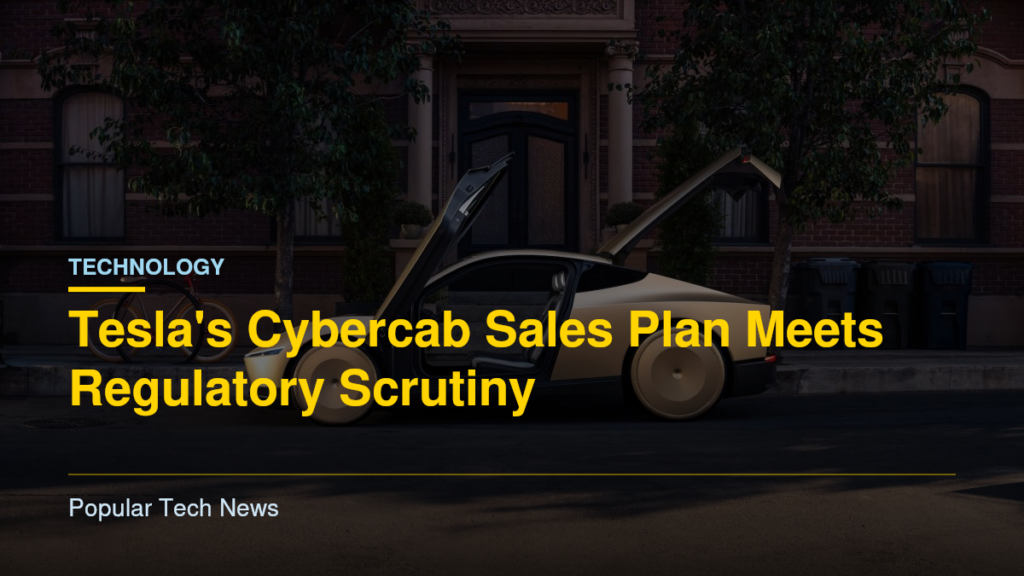
Tesla will start selling its autonomous Cybercab to customers by the end of the year, the company said during its third-quarter earnings call on Wednesday, even as federal regulators investigate whether the vehicle meets federal motor vehicle safety standards. The gold-hued, two-seat robotaxi has no steering wheel or other traditional manual controls, a design that puts it at the centre of a regulatory question about how self-driving vehicles are certified for public roads.
A Fleet-First Sales Strategy
Lars Moravy, Tesla's vice president of engineering, said the Cybercabs produced today are all destined for the company's own robotaxi fleet. As that fleet grows, Tesla will "mainly deliver fully designed autonomous vehicles to our customers," he said, adding that the programme will start small and scale as the company learns about delivery, ownership and fleet management of autonomous vehicles. The idea of selling the vehicle to third parties was first floated last month around Tesla's Cybercab event in Austin, when the company posted a form for people interested in buying robotaxis. Until Wednesday's call, it was not clear whether Tesla would follow through or how.
A Shift in Tesla's Robotaxi Ambitions
For years, CEO Elon Musk has talked about building a massive fleet of low-cost robotaxis, but the plan centred on turning privately owned Tesla vehicles into self-driving taxis through a software update. That plan has yet to materialise. Today, Tesla owners can subscribe to Full Self-Driving (Supervised), an advanced driver-assistance system that automates many driving tasks but still requires a human driver to remain engaged and ready to take over. Musk said on Wednesday that an unsupervised version of FSD would be rolled out to customers sometime in the second quarter of next year, another delay for owners who bought or subscribed to the software years ago.
If both timelines hold, third-party fleet customers would be able to buy the autonomous Cybercab and potentially operate it as a robotaxi service before Tesla owners get access to the same autonomous capability in their own cars. Musk framed the Cybercab as a ride-hailing vehicle rather than a consumer car. "Cybercab is primarily going to be something that is offered as like transport as a service, whereas our other cars would be more, you know, the cars that you'd want to own, like the 3 and the Y and whatnot, and the Roadster, obviously," he said. "But, you know, the vast majority of the Cybercab stuff will be essentially Tesla-owned and transported as a service."
The Regulatory Roadblock
The National Highway Traffic Safety Administration opened an investigation into the Cybercab last month, hours after the vehicles began operating on public streets in Austin. Federal Motor Vehicle Safety Standards require manual controls such as brake pedals, along with features including rearview and side mirrors. Automakers traditionally self-certify compliance with FMVSS rules, and Tesla did the same. Current regulations do not accommodate vehicles without manual controls, though the Department of Transportation recently proposed removing those requirements for vehicles designed to be autonomously driven. In the meantime, NHTSA said it would investigate the Cybercab to "examine the process and technical data on which Tesla relied when certifying the Cybercab and related issues." The outcome of that investigation could affect whether Tesla, or anyone else, can legally operate the Cybercab.
What the Timeline Means
The gap between the Cybercab sales timeline and the FSD rollout is notable for developers and fleet operators watching the autonomous vehicle space. Tesla is effectively proposing to sell a vehicle with no manual controls to third-party operators before it has delivered unsupervised self-driving software to its existing consumer fleet, a sequence that raises questions about liability, certification and operational readiness. The company has not detailed how it will handle insurance, remote monitoring or incident response for third-party Cybercab operators, and the NHTSA probe adds uncertainty to any delivery schedule. For now, the end-of-year target is a statement of intent rather than a confirmed production and delivery plan, and the regulatory review will determine whether the Cybercab can move from Tesla's own Austin operations to customer fleets at all.