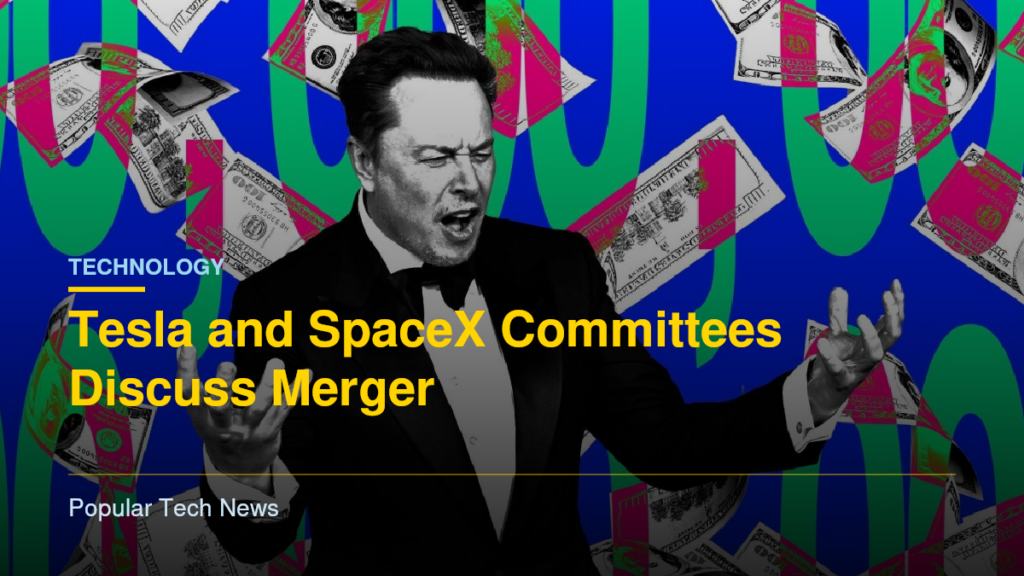
Elon Musk used SpaceX's third-quarter earnings call on Tuesday to disclose that Tesla and SpaceX have each formed special committees to explore a possible merger between the two companies he runs. The disclosure turns a long-running Wall Street hypothesis into a formal corporate process, but it stops well short of a deal: no terms have been agreed, and Musk said he is deliberately walled off from the talks.
A conflicted CEO steps back
Musk said the committees were created at shareholders' request and are made up of independent directors, though he did not identify them. He is not a member of either body and is not participating in the discussions. "Because I'm a conflicted party, I can't actually be in the discussions of the special committees," he said, describing the arrangement as "an odd kabuki dance where two groups of people are talking and I can't be in the conversation."
That structure matters for anyone modelling the deal. With the same person as chief executive of both sides, independent-director committees are the standard mechanism for insulating negotiations from conflict-of-interest challenges — the same governance question that has shadowed Musk's pay arrangements at Tesla. The committees, not Musk, control whether a transaction reaches shareholders at all.
The 50 percent hurdle
Even if the committees agree on terms, Musk flagged the vote as a serious obstacle. "At the end of the day, the shareholders have to be supportive of this," he said. "And particularly on the Tesla side, we will need a 50 percent vote of all shares, not just those who vote, but of all shareholders. And that's quite a high hurdle to try to achieve."
That is a materially harder threshold than a typical majority-of-votes-cast standard, because abstentions and non-participating holders count against approval. Any deal would also need SpaceX shareholder backing, and Musk offered no timetable for either committee to report.
Why Musk argues the combination has merit
Musk nonetheless called the idea "a good idea," arguing the two companies increasingly overlap in engineering. "I do think there's a lot of merit to combining companies as we are pretty much in the superintelligence singularity," he said, citing cooperation on superintelligence software, chip design, the TeraFab, robotics, mass to orbit with the Starmind constellation, and connectivity. He added that the outcome rests with the two committees, which must produce a proposal before shareholders vote.
For engineers, the logic is less about corporate structure than about shared dependencies: AI compute, custom silicon, robotics and launch capacity are converging into a single technology stack, and a merged entity would concentrate control of that stack under one balance sheet.
A $3.6 trillion question with real trade-offs
A combination would create a mega-entity valued at upwards of $3.6 trillion, but the direction of the deal changes everything. Buying SpaceX would require Tesla to issue millions of new shares, diluting existing Tesla holders. SpaceX's launch ambitions also demand tens of billions of dollars annually — spending that could compete with Tesla's capital needs for new vehicle factories and battery plants.
Most Wall Street analysts and legal experts expect the reverse: SpaceX acquiring Tesla or absorbing it through a stock swap. SpaceX has held a higher valuation than Tesla since its IPO, and that structure would leave SpaceX holders with majority control of the combined company. Some Tesla shareholders may resist that outcome, even as others would gain a single vehicle for Musk's robotaxi, humanoid robot, AI and Mars-habitat ambitions. Tesla investors approved Musk's large pay package last year even after a Delaware judge voided it over independence concerns — a signal of how that base has voted on Musk-aligned proposals before.
What to watch before December 3
Earlier this month, Barclays published a client note suggesting a Tesla-SpaceX combination could be announced ahead of Tesla's annual shareholder meeting, scheduled for December 3, 2026. That is a bank's speculation, not a disclosed plan, and it should be treated as such until the special committees produce something concrete.
Until then, the verifiable facts are narrow: two committees exist, independent directors staff them, Musk is excluded, no terms are agreed, and Tesla's all-share 50 percent threshold stands in the way. Everything beyond that — deal direction, exchange ratio, timing — remains unconfirmed.