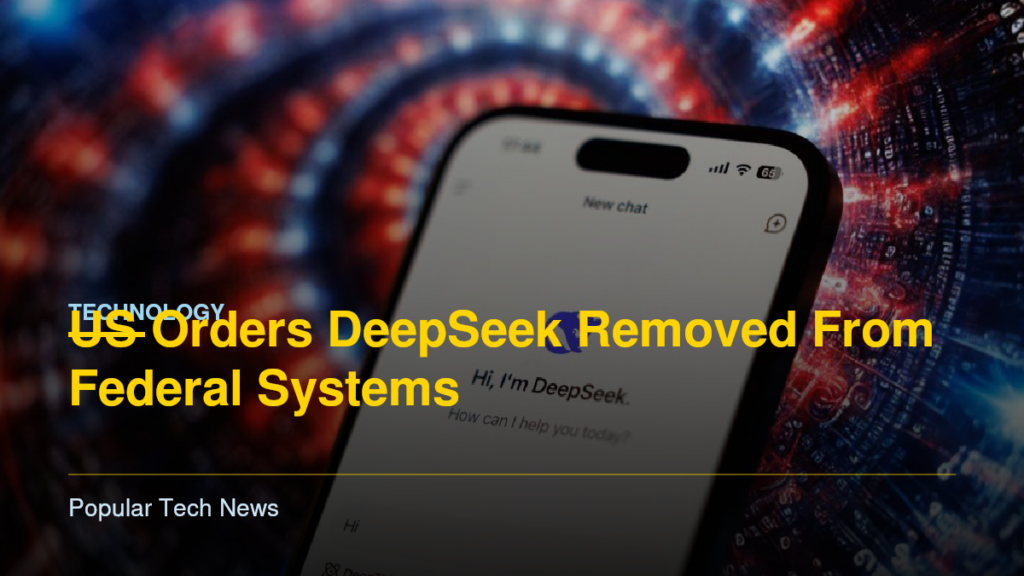
The U.S. government has ordered federal civilian agencies to halt purchases of products and services from Chinese AI startup DeepSeek and to remove its technology from government IT systems, according to the Department of Homeland Security. The directive, reported by TechCrunch, marks a significant escalation in the technology standoff between Washington and Beijing, extending restrictions that previously targeted intelligence systems to the broader civilian federal apparatus.
Scope of the Order
The order is notable for its breadth. It does not merely ban DeepSeek's own applications and services; it also covers third-party products and services built using DeepSeek technology. That means agencies must audit their software supply chains for embedded DeepSeek components, not just uninstall a single app. Agencies can request exceptions, but the default posture is removal and prohibition on new procurement.
DHS cited national security concerns tied to DeepSeek's operations in China. Specifically, the department warned that sensitive information from U.S. government users could potentially be accessible to Chinese authorities under Chinese law. The order reflects a growing unease about data governance in AI systems developed under jurisdictions where government access to data is legally mandated.
Background: From Intelligence Systems to Civilian Agencies
The move builds on earlier congressional action. A law passed in December 2025 targeted DeepSeek's use in intelligence and national security systems. The latest order extends those restrictions to federal civilian agencies, covering both new purchases and existing IT systems. The progression suggests a deliberate, phased approach to removing Chinese AI technology from government infrastructure.
DeepSeek has been under global scrutiny since its R1 reasoning model shook the AI industry in January 2025, triggering a sharp sell-off in Nvidia shares. The model challenged U.S. rivals including OpenAI and Meta with low-cost open-weight models, upending assumptions about the cost of frontier AI development. Its open-weight distribution model has made it attractive to developers and organizations looking to deploy capable AI without large licensing fees, but that same openness complicates efforts to control its spread.
Distillation Allegations and Industry Tensions
The U.S. has accused DeepSeek and five other Chinese AI companies, including Alibaba and Moonshot AI, of using large-scale model distillation to extract information from American AI systems, according to a September report. Model distillation is a technique that uses outputs from one AI model to train another. OpenAI and Anthropic have separately raised concerns about DeepSeek's alleged use of the method. Earlier this year, OpenAI told U.S. lawmakers it had observed suspected attempts by DeepSeek to distill its models, while Anthropic said it had identified unauthorized attempts by DeepSeek and other Chinese AI labs to collect outputs from Claude.
These allegations add a technical dimension to the policy dispute. Distillation is a common and often legitimate practice in machine learning, but when used to replicate proprietary model behavior at scale, it raises questions about intellectual property and terms of service. The accusations have fueled arguments in Washington for tighter controls on AI model access and export.
China's Response and Export Controls
Beijing pushed back against the U.S. move. Foreign Ministry spokesperson Mao Ning said Tuesday that China opposes "overstretching the concept of national security and politicizing technology and trade issues," according to an official briefing. "We will resolutely safeguard the legitimate rights and interests of Chinese enterprises," the spokesperson added.
Meanwhile, China is reportedly considering export restrictions on 23 AI-related technologies, including chip designs and certain advanced AI models, to address security and misuse risks, Bloomberg reported last week. That move would mirror U.S. export controls on advanced semiconductors and AI technology, suggesting a tit-for-tat dynamic in which both governments are using trade and technology restrictions as instruments of national security policy.
Implications for Developers and IT Leaders
The order has practical consequences beyond government agencies. Contractors and vendors serving federal civilian agencies will need to verify that their products do not incorporate DeepSeek models or services, or risk losing government business. For enterprise IT leaders, the directive signals that supply-chain due diligence for AI components is becoming a compliance requirement, not just a best practice. Organizations that have adopted DeepSeek's open-weight models for cost reasons may face pressure to document their provenance and data flows.
The broader trajectory points toward deeper decoupling of U.S. and Chinese AI ecosystems. With Washington restricting Chinese AI in government systems and Beijing considering export limits on its own AI technologies, the space for cross-border collaboration is narrowing. For developers, the practical effect is a fragmented AI stack, where model choice increasingly carries geopolitical as well as technical implications.