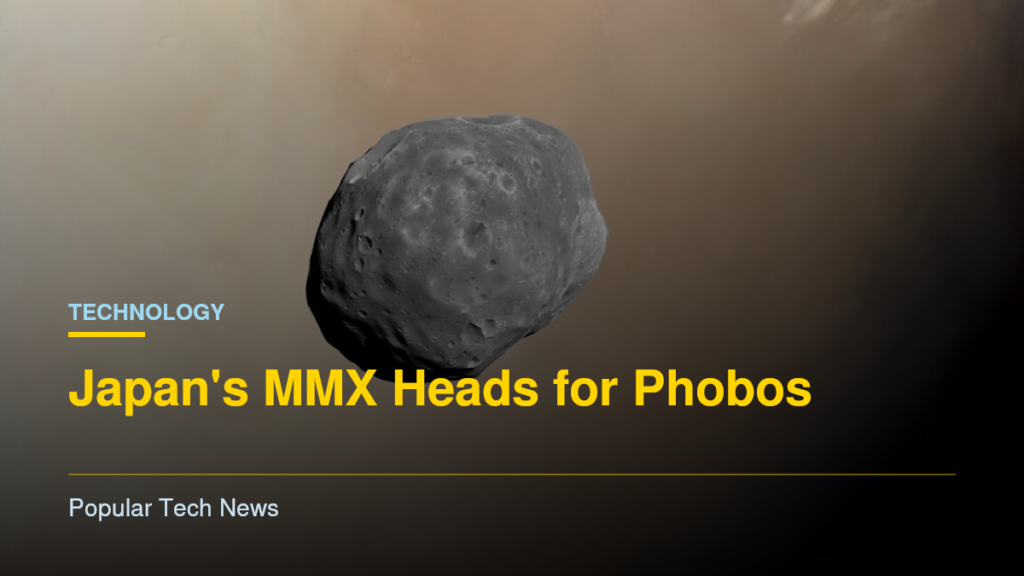
Japan launched a $578 million mission Monday to bring back samples from Phobos, the larger of Mars's two moons, a five-year expedition that could settle a long-running debate about how the Martian moons formed. The robotic Martian Moons eXploration spacecraft, or MMX, lifted off at 3:41 pm EDT Monday (4:41 am Japan Standard Time Tuesday) from Tanegashima Space Center in southern Japan, riding a 207-foot-tall H3 rocket into orbit.
A new H3 configuration for Japan's heaviest interplanetary mission
The launch used a souped-up H3 configuration making its debut: four strap-on solid rocket boosters, main engines running at full throttle, and an extended payload shroud sized to accommodate the spacecraft. The rocket's upper stage pushed MMX to more than 24,000 mph, fast enough to escape Earth's gravity for the 10-month cruise to Mars. The nearly 9,900-pound (4.5-metric ton) spacecraft, two-thirds of which is propellant, separated from the H3 about 71 minutes after liftoff.
JAXA president Hiroshi Yamakawa declared the launch a success. "A long journey of five years has just started," he said. Mission project manager Yasuhiro Kawakatsu said MMX established contact with ground controllers, unfurled its solar panels and was in a "very stable condition" shortly after separation. Japan's science minister, Yoshihiro Seki, called it a challenging mission aiming for the world's first sample return from the Martian moons.
Building on Hayabusa's sample-return legacy
The mission extends Japan's run of deep-space sample returns. The Hayabusa and Hayabusa 2 missions were the first two spacecraft to bring pristine specimens back from asteroids, and Kawakatsu described sample return as a specialty of Japan's space program. That track record helped attract contributions from NASA and European space agencies, he said, because partners judged that joining a Japanese-led mission was more certain to succeed than launching their own.
Scientists believe Phobos could be an asteroid captured into orbit around Mars billions of years ago, and one of MMX's goals is testing that theory. Phobos is a lumpy, potato-shaped body about 14 miles (22 kilometers) across on average, with a surface area comparable to Houston.
A quasi-satellite orbit and a shoebox rover
MMX arrives at Mars next August and will spend about three years there, making repeated encounters with Phobos and Deimos. After entering orbit around Mars, it will jettison its propulsion module, leaving the exploration module and its four-legged landing gear. Because Phobos's gravity is too weak and Mars's pull too strong for a stable orbit around the moon, the spacecraft will fly a quasi-satellite orbit bound to Mars while maneuvering around Phobos.
In late 2028 or early 2029, the mothership will release a small rover called Idefix, a French and German space agency contribution the size of a large shoebox. The four-wheeled robot will try to drive across Phobos for up to 100 days in gravity less than one-thousandth of Earth's. Later in 2029, the main spacecraft will attempt up to two landings, with landing gear designed to absorb impact energy and reduce the risk of tipping or bouncing back into space. It will stay on the surface for several hours, using a coring drill on its robotic arm to extract a cigar-shaped specimen and a NASA-provided pneumatic sampler on a landing leg that fires high-pressure nitrogen gas to sweep material into a canister.
Why Phobos matters
Scientists expect MMX to collect at least 10 grams (about one-third of an ounce) of material. The spacecraft will discard its landing gear, fire its engines in 2030 and send a sample capsule to a remote landing zone in South Australia in 2031. Analysis will take place in Japanese laboratories, with US researchers receiving 15 percent of the specimens in exchange for NASA's contributions, which include one sampler and a gamma-ray and neutron spectrometer to measure the elemental makeup of the moons.
NASA's Tom Statler said the central question is why Phobos and Deimos exist at all. The moons resemble asteroids from the outer asteroid belt, suggesting capture, but other evidence points to debris from a giant impact early in Mars's history; returned samples could distinguish between the two. Phobos orbits roughly 40 times closer to Mars than the Moon does to Earth, so samples may also contain traces of Mars itself that fell onto the moon, offering an early look at material that would otherwise require a far harder Mars sample return. MMX's reconnaissance could also inform planners weighing Phobos as a stopover for human missions. Earlier attempts failed: Russia's Phobos-Grunt was lost after launch in 2011, and two Soviet spacecraft carrying Phobos landers in 1988 were lost before completing their missions.