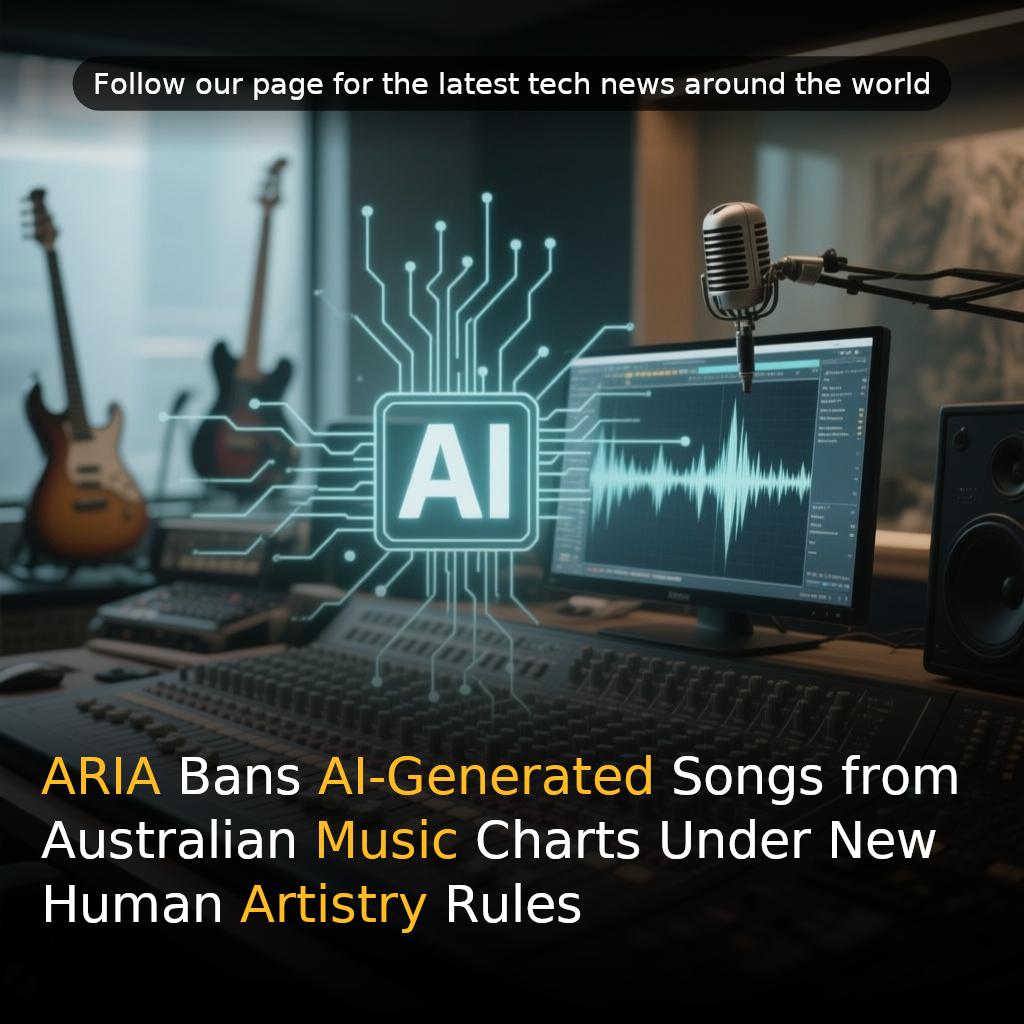
The Australian Recording Industry Association (ARIA) has updated its chart rules, making songs created entirely or predominantly by artificial intelligence ineligible for inclusion on Australian music charts. Under the new guidelines, a track must be ‘substantially human made’ to qualify for chart placement.
Key takeaways
- ARIA now requires songs to be ‘substantially human made’ to qualify for Australian music charts.
- Artists can still use AI in their workflow, but songwriting, lead vocals, and primary instrumental performances must be by humans.
- The policy change follows controversy over an AI-assisted cover of Madonna’s ‘Like A Prayer’ by Australian DJ Josh Fawaz, which reached number two on Australia’s overall chart.
- Artists must disclose AI use when submitting songs, and ARIA can retroactively adjust chart positions and request awards back if rules are violated.
- ARIA chief executive Annabelle Herd says the rules keep charts open to artists using emerging technology while preventing wholesale AI-generated music from being rewarded.
ARIA’s new AI chart rules
The Australian Recording Industry Association stated that the revised rules are designed to safeguard the human element in music and to highlight the human nature of artistry. According to the updated regulations, artists may still incorporate AI into their creative workflow, but the songwriting, lead vocals, and primary instrumental performances must be carried out by humans.
The new rules continue to permit AI-assisted mastering, drum machines, and Auto-Tune in music production. This means producers can still use modern tools, but the core creative elements must come from human artists.
What prompted the change?
The policy change was prompted by a controversy over an AI-assisted cover of Madonna’s ‘Like A Prayer’ by Australian DJ Josh Fawaz. Fawaz’s AI-assisted cover had reached the top of the ARIA dance singles chart and had climbed to number two on Australia’s overall chart. The track had reportedly been streamed more than 48 million times on Spotify.
Following criticism about the use of AI, Fawaz added generative AI credits to the song. ARIA explained that Australian artists are vying for attention in an increasingly crowded music market and that it does not want to reward music generated without meaningful human artistry.
How the rules work
Under the new code, artists and their representatives must disclose any use of AI when submitting songs for chart consideration. ARIA has the ability to retroactively adjust a song’s chart position if it is later discovered that the music was largely AI-generated.
If a song reaches number one and is later found to violate the rules, ARIA may request that awards given for reaching the top position be returned. Artists and their representatives will have the opportunity to challenge an exclusion from the charts.
Industry reaction
ARIA chief executive Annabelle Herd said the updated rules are intended to keep the charts open to artists who use emerging technology while preventing wholesale AI-generated music from being rewarded. Herd stated that artists already use AI tools in their work and that the charts can and should evolve to keep room for that. She added that music generated wholesale by services built on artists’ recordings was a different matter.
Australian electronic duo Peking Duk is among the artists supporting the new rules. The duo recently shared an AI-assisted version of its 2014 hit ‘High’ on Instagram, joking that it had re-recorded its own song with AI so Australian radio would play it. Band member Adam Hyde later said AI-generated music was ‘removing the human experience from life’.
Broader context
Earlier this year, a song was removed from Sweden’s music charts because it was created using AI. The International Federation of the Phonographic Industry (IFPI) announced in July that AI-related chart guidelines would be introduced across Latin America, the Middle East, Africa, and Southeast Asia.
These moves reflect a growing global effort to address the role of AI in music, balancing innovation with the protection of human artistry. As AI tools become more accessible, chart authorities are adapting their rules to ensure that musical achievements remain a reflection of human creativity.