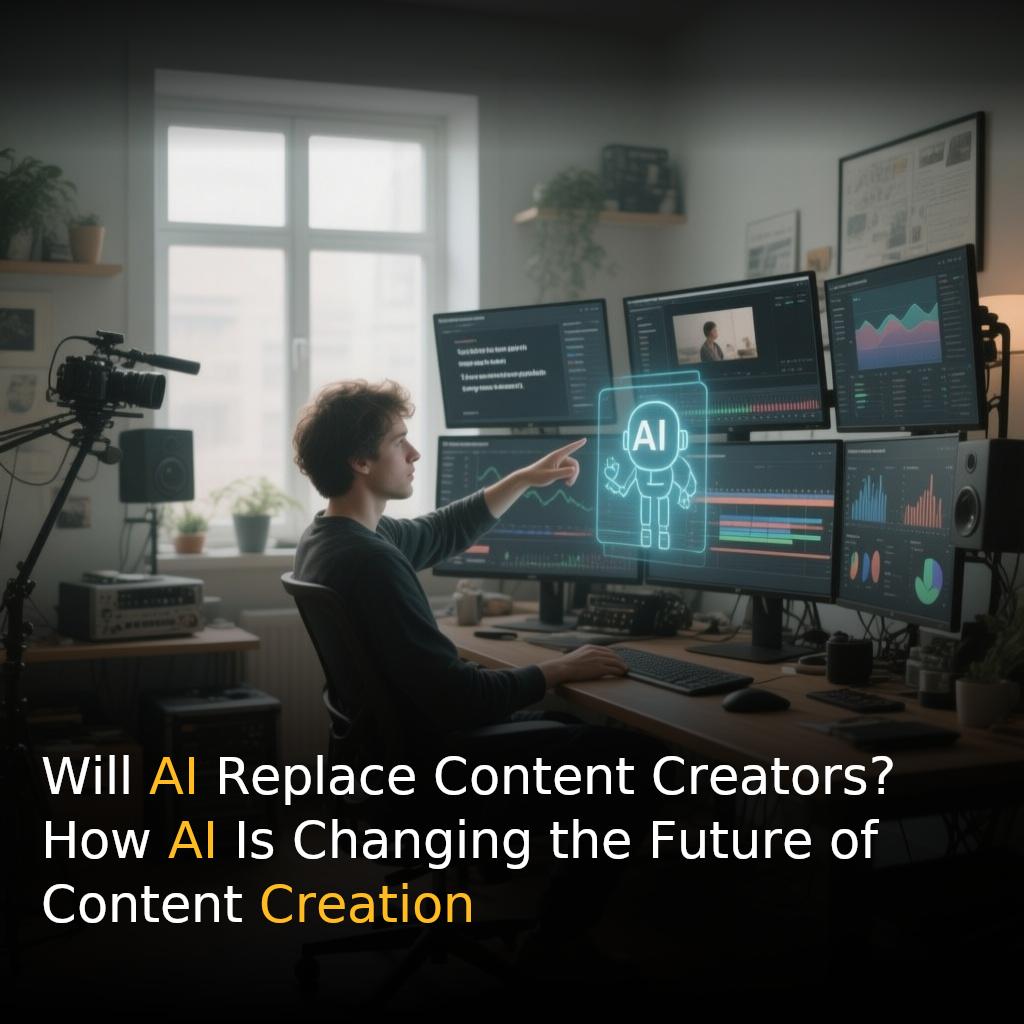
Artificial intelligence is rapidly reshaping the creator economy, but will it replace content creators? A new analysis of the 2025 Adobe Creator Survey suggests a more nuanced future: AI is automating many production tasks while boosting the productivity and growth of creators who embrace it. The evidence points not to a wholesale replacement of human creators, but to a powerful partnership—humans plus AI.
AI Is Already Changing How Creators Work
The data shows that AI has moved from an experimental tool to a core part of the creator workflow. According to the 2025 Adobe survey, 86% of creators are now actively using creative generative AI. This isn’t a fringe technology; it’s becoming standard practice.
Creators are using AI across nearly every stage of content production. The most common uses include editing, upscaling, and enhancement (55%), generating new assets like images and video (52%), and brainstorming and ideation (48%). Most creators aren’t relying on a single tool either—60% use more than one creative AI tool.
This integration is already delivering results. 87% of creators using creative AI reported that it accelerated the growth of their business or audience, and 76% said AI accelerated their business or follower growth specifically. Perhaps most tellingly, 81% said AI helps them create content they otherwise could not have made. For many, AI is not a threat but an enabler of new creative possibilities.
From One Creator to a One-Person Media Company
One of the most profound changes is how AI levels the playing field. Historically, producing high-quality video, graphics, and written content required a team of specialists. Now, AI tools allow a single creator to perform work that previously required a larger team.
This is the rise of the one-person media company. AI can handle research, draft scripts, generate images and video, edit footage, enhance audio, and even translate content for global audiences. It can also assist with SEO, social media posts, and analytics, giving a solo creator the capabilities of a small production studio.
The potential is amplified by agentic AI—systems that can work autonomously toward a goal. 70% of creators said they are optimistic or excited about agentic AI. In the future, such agents could research topics, create content, repurpose it for different platforms, publish it, and analyze its performance, all with minimal human oversight. This could transform a single creator into a media organization, operating on a scale previously unimaginable.
Will AI Actually Replace Content Creators?
The central question—will AI replace content creators?—deserves a nuanced answer. The evidence strongly suggests that AI will replace many tasks, but not the creator.
Creators themselves are clear on this distinction. 85% of creators said the final creative decision should remain with the creator. They see AI as a tool to execute their vision, not as a replacement for their judgment. This sentiment is reinforced by the fact that 75% described creative AI as integrated or essential to their workflow, yet they still see themselves as the driving force.
What’s more, 85% of creators would consider AI that learns their creative style, indicating a desire for AI to augment their unique voice, not replace it. The tasks most likely to be automated are repetitive ones—51% of creators want AI to automate repetitive tasks, and 50% want AI for brainstorming. These are the time-consuming, lower-level parts of the job.
What becomes more valuable are the human skills that AI cannot replicate: personality, experience, expertise, opinions, storytelling, and the ability to build genuine relationships with an audience. These are the elements that create trust and loyalty, and they remain firmly in the human domain.
The Dark Side: An Internet Flooded With AI Content
While AI offers incredible opportunities, it also presents a significant threat: content saturation. The ease of generating content with AI could lead to a flood of low-quality, repetitive material, often referred to as “AI slop.”
Platforms are already responding. YouTube has clarified that mass-produced and repetitive content can be considered “inauthentic content” and is not eligible for monetization. This is a direct attempt to curb the spread of low-effort AI-generated videos that lack original value.
However, YouTube also allows AI to be used as a production and storytelling tool when creators follow platform policies. The line is between using AI to enhance creativity and using it to spam the platform. As AI becomes more widespread, the ability to create content that stands out—that is genuinely original, insightful, and authentic—will become more critical than ever.
Why Authenticity Could Become More Valuable
In a world where AI can generate endless variations of similar content, the human element becomes a premium commodity. Audiences are increasingly drawn to creators who offer a unique perspective, a distinct personality, and a genuine connection.
This is where the data on creator concerns becomes relevant. 69% of creators are concerned about their content being used to train AI without permission. This fear highlights the value of original work and the desire to protect one’s unique creative output. It also points to a growing demand for transparency and control over how creative work is used.
As AI-generated content becomes indistinguishable from human-made content, the ability to prove authenticity and build trust with an audience will be a key differentiator. Creators who can offer a real, human perspective—with all its imperfections and unique insights—will likely find that their value increases, not decreases.
AI Influencers Are Changing the Meaning of “Creator”
The rise of AI influencers and virtual personalities adds another layer of complexity. These are not human creators using AI tools; they are entirely synthetic entities with automated content and, in some cases, automated brands.
This development challenges the very definition of a “creator.” Can an AI influencer be considered a creator? Who owns the content it produces? Will audiences trust AI influencers as much as human ones?
While the data shows that creators are optimistic about agentic AI, the public’s trust in AI influencers is an open question. The success of such entities will likely depend on their ability to engage audiences emotionally, which is a distinctly human trait. It’s possible that AI influencers will carve out a niche, but they are unlikely to replace the deep connection audiences feel with human creators.
Copyright, Ownership and the Fight Over Creative Work
The integration of AI into content creation has sparked a major debate over copyright and ownership. The core concern is that AI models are trained on vast datasets that often include creators’ work without explicit permission.
This is a significant worry for the creator community. 69% of creators are concerned about their content being used to train AI without permission. The lack of clarity around licensing, attribution, and ownership is a major barrier to adoption. 28% of creators cited uncertainty about how AI models were trained as an adoption barrier, and 38% cited cost.
These issues are not just technical; they are fundamental questions about the value of creative work and who controls it. The outcome of these debates will shape the future of the creator economy. Creators will need to navigate a complex landscape of rights, and platforms and AI developers will need to establish fair practices for using creative data.
How AI Could Change Creator Jobs
AI is not just changing how content is made; it’s changing the very nature of creator jobs. The shift is from being a producer who handles every aspect of production to a creative director who oversees AI tools and makes high-level decisions.
This means creators will need to develop new skills. The ability to prompt AI effectively, curate its outputs, and ensure quality will become essential. They will also need to focus on the parts of the job that AI cannot do: developing a unique voice, building a community, and making strategic decisions about their brand.
The skills that become more valuable are those that are inherently human: creativity, critical thinking, emotional intelligence, and the ability to tell compelling stories. While AI can generate content, it cannot replicate the lived experience and unique perspective that a human creator brings to their work.
The Rise of AI Creative Agents
Looking ahead, the most significant development may be the advent of AI creative agents. These are sophisticated AI systems that can autonomously perform a series of tasks to achieve a creative goal.
Imagine a creator who wants to launch a new YouTube channel. An AI agent could research trending topics, write scripts, generate video footage, edit the final product, optimize the title and description for SEO, publish the video, and then analyze the performance data to suggest improvements for the next video.
This level of automation could dramatically increase the output of a single creator. 70% of creators are optimistic or excited about agentic AI, seeing it as a way to scale their efforts without sacrificing quality or their personal touch. This is the engine of the one-person media company, and it’s likely to become a reality within the next few years.
What Will a Content Creator Look Like in 2030?
Predicting the future is always speculative, but the trends suggest a clear direction. By 2030, the content creator may look less like a producer and more like a creative director.
This creator will be a master of AI tools, using them to handle the heavy lifting of production. They will focus on strategy, ideation, and the human elements that resonate with audiences. They will likely use AI agents to manage the entire content lifecycle, from research to analytics.
However, this is a prediction, not a certainty. The future will depend on how creators, platforms, and AI developers navigate the challenges of copyright, authenticity, and content saturation. The creators who thrive will be those who learn to use AI effectively while maintaining their unique human voice.
Human Creativity vs. Artificial Intelligence
The debate over whether AI will replace creators often frames the issue as a battle between human creativity and artificial intelligence. This is a false dichotomy. The evidence suggests that the most successful creators will be those who combine the best of both.
AI excels at tasks that are repetitive, time-consuming, and data-driven. It can generate variations, optimize for algorithms, and process vast amounts of information. Human creators excel at tasks that require emotion, judgment, experience, and a personal connection. They can tell stories, express opinions, and build trust.
The future is not humans vs. AI, but humans + AI. The creators who embrace this partnership will be more productive, more creative, and more resilient than those who don’t.
The Future Is Probably Human + AI
So, will AI replace content creators? The most likely answer is no—but it will replace many of the tasks they perform. The creator’s role will evolve, but the need for human creativity, judgment, and connection will remain.
AI is not a substitute for the human experience. It cannot replicate the personal journey, the unique perspective, or the emotional bond that a creator builds with their audience. These are the elements that make content resonate, and they are irreplaceable.
The creators most likely to thrive in this new era will not be those who avoid AI, but those who learn to use it as a powerful collaborator. They will use AI to amplify their creativity, not replace it. The future of content creation is not a choice between human and machine; it is a partnership that unlocks new possibilities for both.