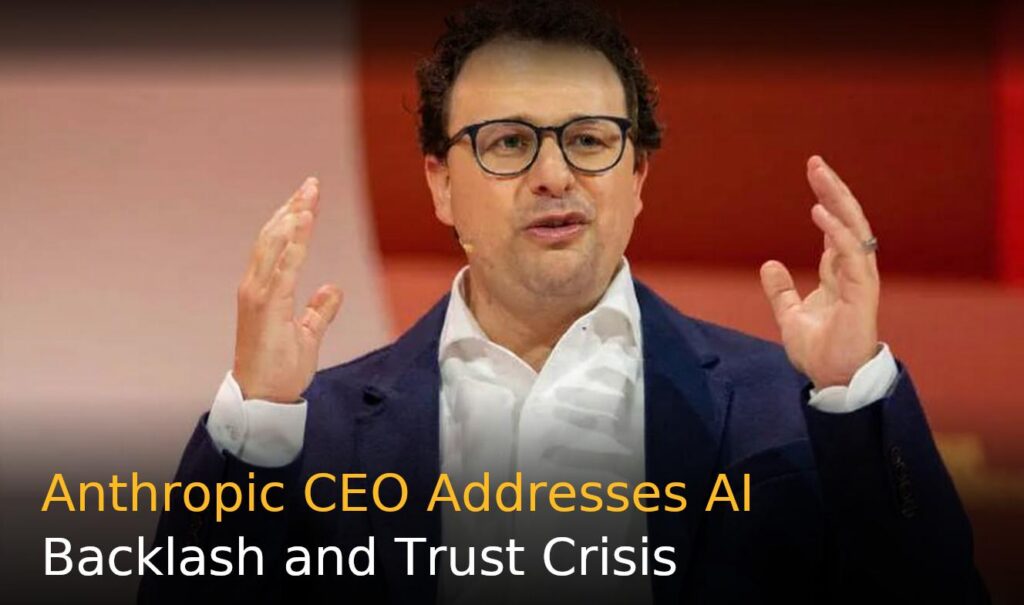
Anthropic CEO Addresses AI Backlash and Public Trust
Dario Amodei, the chief executive of Anthropic, has publicly pushed back against the notion that his own warnings about artificial intelligence risks are responsible for the growing public opposition to the technology. Instead, he attributes the widespread skepticism to a deeper, more fundamental "crisis of trust" that has been building for decades.
Amodei's comments came in response to investor Gavin Baker, who had argued on the All-In podcast and on social media platform X that the Anthropic leader's cautionary statements about AI contributed to rising opposition to data centres and AI development across the United States. Baker also suggested that Amodei, as the head of one of the world's most influential AI companies, should adopt a more optimistic and positive tone in his public communications.
A Crisis of Trust, Not a Messaging Problem
Amodei directly disagreed with the characterization that his messaging has been disproportionately negative or harmful to the industry's image. He maintained that his writing has been broadly balanced, covering both the potential risks and the significant benefits of artificial intelligence.
He explained that his widely discussed essay, Machines of Loving Grace, was written partly because he felt the tech industry had failed to present a sufficiently inspiring vision of how AI could improve the world. Despite this, Amodei acknowledged that public perception of AI is currently negative, calling it a "big problem."
"I think it is fundamentally a crisis of trust," Amodei said.
He elaborated that ordinary people often harbor deep suspicion toward companies, governments, and the technology industry as a whole, frequently believing that these powerful institutions are developing new methods to harm or exploit them. Amodei noted that this distrust has accumulated over several decades, and the current backlash against AI is simply the latest expression of that long-standing sentiment.
The Need to Deliver on Promises
When discussing the most substantial criticism facing AI companies, including his own, Amodei pointed to the failure to deliver on major promises. He acknowledged that the industry has not yet fulfilled its grand commitments to benefit society in tangible ways.
Amodei argued that simply making ambitious claims about AI's potential to transform healthcare or cure diseases would not be enough to convince skeptics. Instead, he stressed that the industry must prove its value by demonstrating these benefits in real-world applications and practice, rather than relying on theoretical potential.
Defending Regulation and Addressing Power Concentration
Amodei also rejected what he described as a false dichotomy: the choice between allowing AI to develop without any regulation or, conversely, using regulation to concentrate the technology among a small number of dominant companies. He acknowledged that in Silicon Valley, regulation is often viewed with suspicion, as it can lead to regulatory capture and further entrench the power of large incumbents.
However, he pointed out that many people outside the tech industry see regulation differently—as a necessary tool to limit corporate power and protect the public interest. Anthropic has supported certain AI regulations, including measures that would require greater transparency from major AI companies. Amodei said the company strives to develop policy proposals that could slow down the leading AI firms while simultaneously giving smaller competitors more room to innovate and compete.
AI's Structural Tendency to Concentrate Power
Amodei offered a structural argument about the nature of AI itself, asserting that it is a technology that inherently tends to concentrate power. This is because developing advanced AI models requires massive amounts of computing resources and specialized chips, which are accessible to only a few large players.
He noted that open-weight AI models could help distribute access to the technology more broadly, but he cautioned that they would not fully resolve the underlying concentration problem. According to Amodei, carefully designed regulations could address key risks associated with AI, including cybersecurity threats, biological dangers, and the challenge of AI alignment, while also limiting the institutional power of leading AI companies and preserving space for open-weight models to thrive.
#Anthropic, #ArtificialIntelligence, #AIRegulation, #AITrust, #DarioAmodei