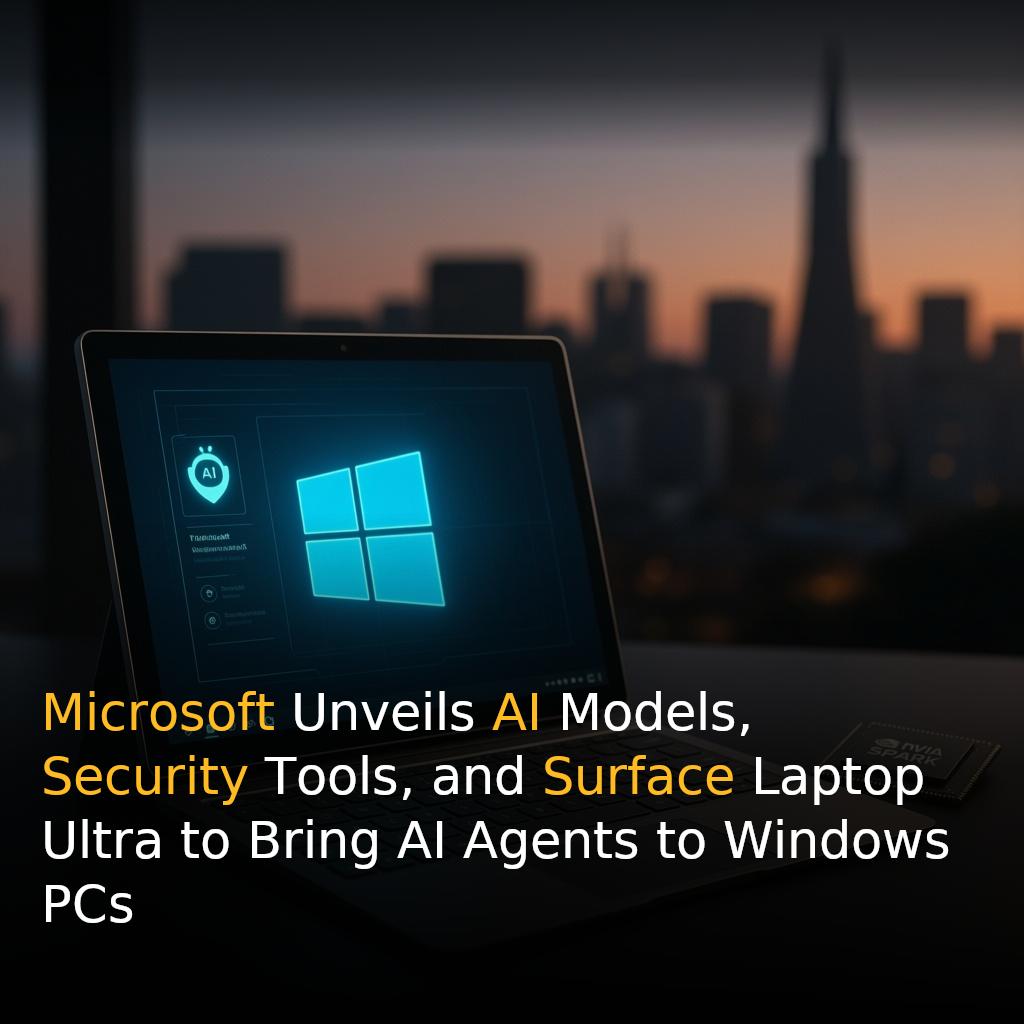
Microsoft has unveiled a sweeping package of new AI models, security technology, and a high-end Surface Laptop Ultra in a major push to bring growing AI use directly to personal computers. The announcements, made during an event in San Francisco on Wednesday, October 7, position Windows as a platform where AI agents can perform complex tasks locally rather than relying solely on the cloud.
Key Takeaways
- Microsoft introduced AI models and security tools designed to run AI agents directly on Windows desktops and laptops.
- The Surface Laptop Ultra, powered by Nvidia chips, starts at $2,599, with high-end configurations reaching $5,899.
- New “Microsoft Execution Containers” aim to prevent AI agents from accessing unauthorized data or systems.
- AI models from Nvidia and DeepSeek can now run locally on powerful Windows machines.
- Rising memory chip costs pose a significant challenge to local AI adoption.
Microsoft Bets on Local AI Agents for Windows
Microsoft aims to enable AI agents to perform a wide range of tasks on Windows devices, from writing code to handling complex business projects. The company also introduced an AI coding model that can run directly on a personal computer, a key step toward making Windows a platform for autonomous agents.
According to Pavan Davuluri, Microsoft’s executive vice president for Windows and Devices, Anthropic, OpenAI, and Nvidia will also use the new security tools. CEO Satya Nadella said the goal is to make the desktop the safest place for AI agents.
Security First: Microsoft Execution Containers
In light of security concerns arising from increasingly autonomous AI agents, Microsoft announced the introduction of “Microsoft Execution Containers.” This technology is designed to prevent AI agents from reaching data or systems on a computer that they are not permitted to access.
Nvidia CEO Jensen Huang described the technology, abbreviated as “MXC,” as a major change in how AI agents are built and used. He added that without this technology, it would not be possible to use AI agents in this manner.
Surface Laptop Ultra and Nvidia Spark Chips
During the San Francisco event, Microsoft also presented the Surface Laptop Ultra equipped with Nvidia’s Spark chips. The device is aimed at users who need powerful local AI processing.
| Model |
Key Specifications |
Price |
| Surface Laptop Ultra (base) |
24 GB memory |
$2,599 |
| Surface Laptop Ultra (high-end) |
20-core processor, 128 GB memory, 1 TB storage |
$5,899 |
| Apple MacBook Pro (comparison) |
40-core graphics chip, 128 GB memory, 2 TB storage |
$6,700 |
| Apple MacBook Pro (base) |
16 GB memory |
$1,999 |
Microsoft’s base Surface Ultra is priced higher than Apple’s $1,999 base MacBook Pro, but Microsoft’s base model has 24 gigabytes of memory while Apple’s base model has 16 gigabytes. The two devices cannot be directly compared, as they target different use cases.
AI Models That Run Locally
Microsoft has also introduced AI models that previously could not run without a cloud connection but can now be used directly on powerful Windows desktops and laptops. Among these is Nvidia’s open-source “Nemotron” model. A version of Chinese company DeepSeek’s V4 model can also run on computers with at least 60 gigabytes of memory, and it has been claimed that this model can outperform OpenAI’s GPT-5 in some tasks involving coding and solving complex problems.
Hybrid Cloud and Local AI with Copilot
Microsoft is also using a combination of cloud and local computing in its Copilot AI assistant. According to Jacob Andreou, head of Copilot, the most difficult tasks will continue on the cloud, but where cost or privacy is more important, tasks can be shifted to local AI models running on the user’s own computer.
Meta’s “Muse” AI assistant will also be available as a local app for Windows devices and will include some of Microsoft’s new security tools. The open-source AI agent system “OpenClaw” will also be able to work with these security technologies.
The Price Challenge: Memory Shortage and Rising Costs
Despite all these developments, the biggest challenge for Microsoft and Nvidia may be the price of these powerful computers. A shortage of memory chips has significantly increased hardware costs.
Two years ago, Microsoft presented the concept of moving some AI tasks to PCs. At that time, most such laptops were priced under $2,000. Now, with memory prices rising, Nvidia’s AI desktop “DGX Spark” has increased in price by about 75 percent after launch to $6,950.
According to Anshul Sagu, an analyst at Moor Insights & Strategy, the situation was the opposite two years ago: at that time software was not ready but hardware was available, whereas now, despite software being ready, hardware has become so expensive that running AI locally appears difficult.
Why It Matters
Microsoft’s move could shift some tasks currently performed in expensive Azure cloud data centers to powerful local Windows computers. This is a market where Microsoft already holds a strong position and where consumers themselves pay for computer hardware costs. Apple is also trying to seize the same opportunity through its new Mac computers.
What Happens Next
Microsoft expects that its new AI models and security tools will be adopted by major AI companies, including Anthropic, OpenAI, and Nvidia. The company’s goal is to make the desktop the safest place for AI agents, as stated by CEO Satya Nadella. The success of this strategy will depend on whether hardware prices can be brought down to make local AI accessible to a broader audience.